'You don`t see something until you have the right metaphor to let you perceive it'.
Robert Stetson Shaw in Thomas, S Kuhn
Making a New Science, New York, 1987. (p.262)
Saturday, 8 August 2009


Re-edits ...
Two re-edits:
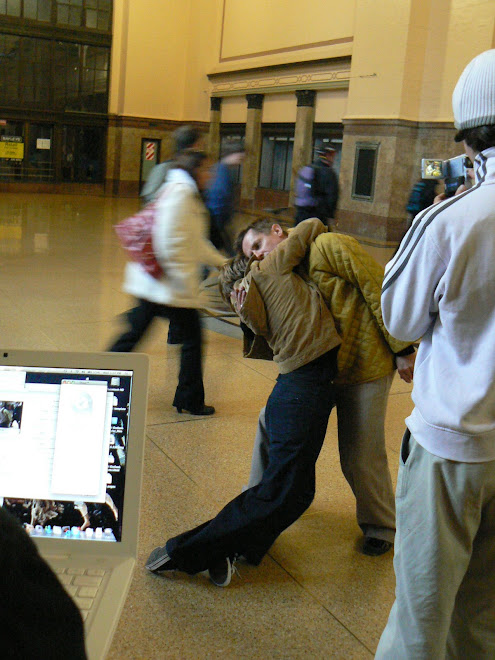
During the course of my assembling works for my powerpoint presentation for the upcoming AUT Art and Design Postgraduate Conference in Auckland on 11 - 14 August, I considered re-working a number of videos. Of these are two re-edits: Cutouts' from 2008 with Fiona Baker and Sylvie Haisman which has been modified to become 'Slippage' and 'Remnants' which has been re-worked from 'Departed - Movement 1 - In the Company of Strangers. In both studies I am investigating ways to maintain the sense of narrative in the duet while exploring a less linear structure in the composition of the pieces.
In this study 'Slippage', within the baseline for the structured improvisation - or more accurately, after Kristian Larsen, 'real-time choreography' (throwdisposeablechoreography blog) the dancers are investigating where and how departure might surface within engagement - hidden agendas of manipulation, potential entrapment and escape - all indeterminants expressed and ultimately brought to nought through the Roaming Body. No matter the intent - we will leave all and every engagement we make. In my editing I am investigating ways to maintain the sense of narrative in the duet while exploring a less linear structure in the composition. I have fragmented the 'conversation' and begun to make this less literal. Movement, as a metaphor and an event in its own right, like other spoken language, need not occur in ways which are linear. In Slippage, I have employed emphasis by changing the speed and timing of the clips and re-ordering the sequence. I am inclined to think that this is an improvement from the original version. There is more diversity visually and less predictability than in the original edit, 'Cutouts'. In Slippage, I have employed emphasis by changing the speed and timing of the clips and re-ordering the sequence. I am inclined to think that this is an improvement from the original version. There is more diversity visually and less predictability.
In the second video below, 'Remnants (Two)', again, I wanted to investigate the potential of this footage for a more circuitous dialogue. I also wanted to combine if I could, the concept of traces or residue left behind on surfaces, as evidence of our presence in the space, with the embodiment of leaving. With this in mind, I took the footage I had made of the station doors and my facial smears on the glass and slowed this down from 100 to 5 percent. This was laid over the existing footage as a slightly opaque screen. The sounds from this piece were also slowed significantly, creating an overlay, a murmur of portent. This provides an extra layer to Mike Beever`s audio and the station sounds. I am interested in how this addition manifests visually, particularly at the very beginning of the clip.
I wanted to break up the existing sequence of movement/narrative/rhythm and re-direct it so I took elements from later in the piece and brought them forward and vice versa and created more of a pastiche of movement/sound by segmenting and replacing the original footage with a different kind of emphasis and articulation.
During the course of my assembling works for my powerpoint presentation for the upcoming AUT Art and Design Postgraduate Conference in Auckland on 11 - 14 August, I considered re-working a number of videos. Of these are two re-edits: Cutouts' from 2008 with Fiona Baker and Sylvie Haisman which has been modified to become 'Slippage' and 'Remnants' which has been re-worked from 'Departed - Movement 1 - In the Company of Strangers. In both studies I am investigating ways to maintain the sense of narrative in the duet while exploring a less linear structure in the composition of the pieces.
In this study 'Slippage', within the baseline for the structured improvisation - or more accurately, after Kristian Larsen, 'real-time choreography' (throwdisposeablechoreography blog) the dancers are investigating where and how departure might surface within engagement - hidden agendas of manipulation, potential entrapment and escape - all indeterminants expressed and ultimately brought to nought through the Roaming Body. No matter the intent - we will leave all and every engagement we make. In my editing I am investigating ways to maintain the sense of narrative in the duet while exploring a less linear structure in the composition. I have fragmented the 'conversation' and begun to make this less literal. Movement, as a metaphor and an event in its own right, like other spoken language, need not occur in ways which are linear. In Slippage, I have employed emphasis by changing the speed and timing of the clips and re-ordering the sequence. I am inclined to think that this is an improvement from the original version. There is more diversity visually and less predictability than in the original edit, 'Cutouts'. In Slippage, I have employed emphasis by changing the speed and timing of the clips and re-ordering the sequence. I am inclined to think that this is an improvement from the original version. There is more diversity visually and less predictability.
In the second video below, 'Remnants (Two)', again, I wanted to investigate the potential of this footage for a more circuitous dialogue. I also wanted to combine if I could, the concept of traces or residue left behind on surfaces, as evidence of our presence in the space, with the embodiment of leaving. With this in mind, I took the footage I had made of the station doors and my facial smears on the glass and slowed this down from 100 to 5 percent. This was laid over the existing footage as a slightly opaque screen. The sounds from this piece were also slowed significantly, creating an overlay, a murmur of portent. This provides an extra layer to Mike Beever`s audio and the station sounds. I am interested in how this addition manifests visually, particularly at the very beginning of the clip.
I wanted to break up the existing sequence of movement/narrative/rhythm and re-direct it so I took elements from later in the piece and brought them forward and vice versa and created more of a pastiche of movement/sound by segmenting and replacing the original footage with a different kind of emphasis and articulation.
Thursday, 16 July 2009
Respecting (Accepting) Avatar Otherness - or Character Creationing
Avatars as a Companion Species?
This post engages with selected texts by Dr Donna Haraway, PhD, who has just had published her latest book, 'When Species Meet'. The text centres upon, in her own words, "... the entanglements of beings in technoculture that work through reciprocal inductions to shape companion species." Haraway is well-known for her cyborg-related scholarship, notably the essay, "A Cyborg Manifesto: Science, Technology, and Socialist-Feminism in the Late Twentieth Century." Though not abandoned, the cyborg now shares her focus with "companion species," the driving figure in her current work.
"... The cyborg is a kind of disassembled and reassembled, postmodern collective and personal self ...". (A Cyborg Manifesto p.163) Haraway elevates the face of the virtual from that of a bipolar mask limited to the displaying of opposing intents, to that of a Universal mask which becomes a multi-dimensional mirror for the self that lies within. In the last twenty years we have been searching for a new or at least extended definition of what post-structuralism has become. Perhaps the recognition and assumption of Cyborg as 'other' will lead us into possible interpretations of ourSelves which will shape this elusive evolution? Haraway makes a compelling argument for this development, "...Communications technologies and biotechnologies are the crucial tools recrafting our bodies. These tools embody and enforce new social relations for women* world-wide. Technologies and scientific discourses can be partially understood as formalizations, i.e., as frozen moments, of the fluid social interactions constituting them, but they should also be viewed as instruments for enforcing meanings. The boundary is permeable between tool and myth, instrument and concept, historical systems of social relations and historical anatomies of possible bodies, including objects of knowledge. Indeed, myth and tool mutually constitute each other..." (p.164) It seems to me that each historical, socio-political 'movement' which eventuates depends upon those tools and their inherent meanings which became available through the context of the previous movement and its associated 'truths'. In the case of postmodernism, those meanings became illuminated through the current tools which concentrated on challenging and deconstructing already established so-called 'knowledge' and the constituents of 'truth'. (A pattern that was not so different from the evolution of most other historical movements, although perhaps never before postmodernism has historicity itself been so challenged). *Within the context of this post, this assertion is not gender-specific.
"... reciprocal inductions to shape companion species", are the words which shape this post. In my latest video posts below, 'Inscribed Surfaces' and 'Shelter 1 and 2', I am concerned with the notion of imbuing, in this instance, my SL avatar, Rollo Kohime, with the inscription of sentient awareness - an impossible task for a so-called virtual avatar existing as a telepresence. I am intrigued with the possibility that in fact, my Second Life avatar, Rollo exists not merely as a construct, separate from myself, but as a construct integral to my-Self. Together, we construct, inform, mediate and are mediated by the interface which apparently lies between us but which is also effectively the territory which upholds the languages and their intent made visible/audible that we share. Taking into account Zizek`s/Lacan`s view on the 'object`s gaze', that the subject`s gaze is always already inscribed into the perceived object itself - and that the object returns this gaze; (Zizek calls the object being imbued with a perceptual power of its own a kind of 'materialism') in this description of the world, Rollo, as object can perceive me and I can also see me through the embodiment/manifestation of Rollo`s perception.
In 2007 I attended the symposium, 'Techno-Praxis' at AUT in Auckland. One of the guest speakers, Dr Kevin Sherman (Archmunster Toll in Second Life) made a very interesting case for the real embodiment of SL avatars and the measure of responsibility and respect that should be afforded them. Sherman was making deliberate forays into claiming this sense of responsibility, not for the people behind the avatars in SL but for the avatars themselves. The online construct-surrogates. He maintained that we humans should be seeking permissions for carrying out certain tasks from the avatars, rather than the people behind the avatars - not in a cursory manner, but genuinely, with humility. Looking around the audience, I remember noticing how appalled most of the assembly was at this notion and I remember too, that I did chuckle inwardly at the group perception of this blatant transgression of human logic! How could this be possible? How could a virtual animation comprised of scripts and digitised intent (this, as the most optimistic descriptor I could think of right now) be afforded the homage of 'respect' through linear, cause and effect thinking?
In the current online discussion forum of, 'empyre' soft_skinned_space, Naxsmash tells us that, 'Haraway's new term 'other-worlding' as a gerund (a noun in English containing an implied action, via the 'ing' in ending) in "When Species Meet," does this beautiful thing of asking the word 'figure' to become a transitive, too. She writes, "Figures help me grapple inside the flesh of mortal world-making entanglements that i call contact zones. The Oxford English Dictionary records the meaning of 'chimerical vision' for 'figuration' in an eighteenth century source, and that meaning is still implicit in my sense of figure. Figures collect the people through their invitation to inhabit the corporeal story told in their lineaments.."'
The term 'chimera', in the freedictionary.com, is defined as: 'a fanciful mental illusion or fabrication' which relates to Chimaera in Greek mythology. I am more interested in Haraway`s useage focussing on the medical interpretation: 'An organism, organ, or part consisting of two or more tissues of different genetic composition, produced as a result of organ transplant, grafting, or genetic engineering.' or 'the ability to form mental images of things or events; "he could still hear her in his imagination"' or, "By the late twentieth century, our time, a mythic time, we are all chimeras, theorized and fabricated hybrids of machine and organism; in short, we are cyborgs. Ths cyborg is our ontology; it gives us our politics. The cyborg is a condensed image of both imagination and material reality, the two joined centres structuring any possibility of historical transformation." (A Cyborg Manifesto: Science, Technology and Socialist Feminism in the Late Twentieth Century, in Simians, Cyborgs and Women: The Reinvention of Nature (New York; Routledge, 1991), pp.149-181.) In other words, it is possible through association, to attach to specific anchors or in this case, figures, certain narratives or stories, qualities, effects, sensations - all corporeal, all real. This last reference relates to the two video posts below: Shelter 1 and 2. One of the many possible readings of these video scenarios may be that Rollo sits in a bus shelter on his way home after a train journey and recollects mental images of my dance duet in Wellington Railway Station. His avatar figure provides the context and vehicle for a real story to be told through the manifestation of his digital lineaments. Who is to say that this story is not true?
I am suggesting that our perception of 'avatar' in today`s technopraxis envisions a certain embodiment of corporeality in their other-worldly makeup. Avatar is becoming-in-the-world more than just a visual construct, more than just an enabled voice or an intent, more than just a chimera - a diversion from the real witnessed in the real. Avatar is all of these things but also post-human. In A Cyborg Manifesto, Haraway asserts that, '... the tradition of reproduction of the self from the reflections of the other ...' are now dominating our lives . The 'other' here, is telepresence itself comprised of miniaturized componentry, its forum for communication the ether - pure quintessence, as Haraway puts it. The avatars which populate Second Life are extensions of ourselves - post-body wishes. "If wishes were fishes we would all cast nets" (Herbert, F. Dune) Well, the nets are rich with avatar inscriptions of the real for many users in MUVE spaces and perhaps also (unwittingly) outside these spaces and within the context of this post title, their descriptions of characterisation which exist vicariously for the user, require no confirmation that what exists is anything other than a prosthesis made to order which has the power, not to merely exist, but to live actively and immersively.
Adam (?) (The provider`s name of this reference is not meant to be either symbolic or ironic) in the current 'empyre' debate on relational 'Queer', in response to Haraway`s text, says,
Adam goes on to talk about the importance of reconceptualizing human identity:
This post engages with selected texts by Dr Donna Haraway, PhD, who has just had published her latest book, 'When Species Meet'. The text centres upon, in her own words, "... the entanglements of beings in technoculture that work through reciprocal inductions to shape companion species." Haraway is well-known for her cyborg-related scholarship, notably the essay, "A Cyborg Manifesto: Science, Technology, and Socialist-Feminism in the Late Twentieth Century." Though not abandoned, the cyborg now shares her focus with "companion species," the driving figure in her current work.
"... The cyborg is a kind of disassembled and reassembled, postmodern collective and personal self ...". (A Cyborg Manifesto p.163) Haraway elevates the face of the virtual from that of a bipolar mask limited to the displaying of opposing intents, to that of a Universal mask which becomes a multi-dimensional mirror for the self that lies within. In the last twenty years we have been searching for a new or at least extended definition of what post-structuralism has become. Perhaps the recognition and assumption of Cyborg as 'other' will lead us into possible interpretations of ourSelves which will shape this elusive evolution? Haraway makes a compelling argument for this development, "...Communications technologies and biotechnologies are the crucial tools recrafting our bodies. These tools embody and enforce new social relations for women* world-wide. Technologies and scientific discourses can be partially understood as formalizations, i.e., as frozen moments, of the fluid social interactions constituting them, but they should also be viewed as instruments for enforcing meanings. The boundary is permeable between tool and myth, instrument and concept, historical systems of social relations and historical anatomies of possible bodies, including objects of knowledge. Indeed, myth and tool mutually constitute each other..." (p.164) It seems to me that each historical, socio-political 'movement' which eventuates depends upon those tools and their inherent meanings which became available through the context of the previous movement and its associated 'truths'. In the case of postmodernism, those meanings became illuminated through the current tools which concentrated on challenging and deconstructing already established so-called 'knowledge' and the constituents of 'truth'. (A pattern that was not so different from the evolution of most other historical movements, although perhaps never before postmodernism has historicity itself been so challenged). *Within the context of this post, this assertion is not gender-specific.
"... reciprocal inductions to shape companion species", are the words which shape this post. In my latest video posts below, 'Inscribed Surfaces' and 'Shelter 1 and 2', I am concerned with the notion of imbuing, in this instance, my SL avatar, Rollo Kohime, with the inscription of sentient awareness - an impossible task for a so-called virtual avatar existing as a telepresence. I am intrigued with the possibility that in fact, my Second Life avatar, Rollo exists not merely as a construct, separate from myself, but as a construct integral to my-Self. Together, we construct, inform, mediate and are mediated by the interface which apparently lies between us but which is also effectively the territory which upholds the languages and their intent made visible/audible that we share. Taking into account Zizek`s/Lacan`s view on the 'object`s gaze', that the subject`s gaze is always already inscribed into the perceived object itself - and that the object returns this gaze; (Zizek calls the object being imbued with a perceptual power of its own a kind of 'materialism') in this description of the world, Rollo, as object can perceive me and I can also see me through the embodiment/manifestation of Rollo`s perception.
In 2007 I attended the symposium, 'Techno-Praxis' at AUT in Auckland. One of the guest speakers, Dr Kevin Sherman (Archmunster Toll in Second Life) made a very interesting case for the real embodiment of SL avatars and the measure of responsibility and respect that should be afforded them. Sherman was making deliberate forays into claiming this sense of responsibility, not for the people behind the avatars in SL but for the avatars themselves. The online construct-surrogates. He maintained that we humans should be seeking permissions for carrying out certain tasks from the avatars, rather than the people behind the avatars - not in a cursory manner, but genuinely, with humility. Looking around the audience, I remember noticing how appalled most of the assembly was at this notion and I remember too, that I did chuckle inwardly at the group perception of this blatant transgression of human logic! How could this be possible? How could a virtual animation comprised of scripts and digitised intent (this, as the most optimistic descriptor I could think of right now) be afforded the homage of 'respect' through linear, cause and effect thinking?
In the current online discussion forum of, 'empyre' soft_skinned_space, Naxsmash tells us that, 'Haraway's new term 'other-worlding' as a gerund (a noun in English containing an implied action, via the 'ing' in ending) in "When Species Meet," does this beautiful thing of asking the word 'figure' to become a transitive, too. She writes, "Figures help me grapple inside the flesh of mortal world-making entanglements that i call contact zones. The Oxford English Dictionary records the meaning of 'chimerical vision' for 'figuration' in an eighteenth century source, and that meaning is still implicit in my sense of figure. Figures collect the people through their invitation to inhabit the corporeal story told in their lineaments.."'
The term 'chimera', in the freedictionary.com, is defined as: 'a fanciful mental illusion or fabrication' which relates to Chimaera in Greek mythology. I am more interested in Haraway`s useage focussing on the medical interpretation: 'An organism, organ, or part consisting of two or more tissues of different genetic composition, produced as a result of organ transplant, grafting, or genetic engineering.' or 'the ability to form mental images of things or events; "he could still hear her in his imagination"' or, "By the late twentieth century, our time, a mythic time, we are all chimeras, theorized and fabricated hybrids of machine and organism; in short, we are cyborgs. Ths cyborg is our ontology; it gives us our politics. The cyborg is a condensed image of both imagination and material reality, the two joined centres structuring any possibility of historical transformation." (A Cyborg Manifesto: Science, Technology and Socialist Feminism in the Late Twentieth Century, in Simians, Cyborgs and Women: The Reinvention of Nature (New York; Routledge, 1991), pp.149-181.) In other words, it is possible through association, to attach to specific anchors or in this case, figures, certain narratives or stories, qualities, effects, sensations - all corporeal, all real. This last reference relates to the two video posts below: Shelter 1 and 2. One of the many possible readings of these video scenarios may be that Rollo sits in a bus shelter on his way home after a train journey and recollects mental images of my dance duet in Wellington Railway Station. His avatar figure provides the context and vehicle for a real story to be told through the manifestation of his digital lineaments. Who is to say that this story is not true?
I am suggesting that our perception of 'avatar' in today`s technopraxis envisions a certain embodiment of corporeality in their other-worldly makeup. Avatar is becoming-in-the-world more than just a visual construct, more than just an enabled voice or an intent, more than just a chimera - a diversion from the real witnessed in the real. Avatar is all of these things but also post-human. In A Cyborg Manifesto, Haraway asserts that, '... the tradition of reproduction of the self from the reflections of the other ...' are now dominating our lives . The 'other' here, is telepresence itself comprised of miniaturized componentry, its forum for communication the ether - pure quintessence, as Haraway puts it. The avatars which populate Second Life are extensions of ourselves - post-body wishes. "If wishes were fishes we would all cast nets" (Herbert, F. Dune) Well, the nets are rich with avatar inscriptions of the real for many users in MUVE spaces and perhaps also (unwittingly) outside these spaces and within the context of this post title, their descriptions of characterisation which exist vicariously for the user, require no confirmation that what exists is anything other than a prosthesis made to order which has the power, not to merely exist, but to live actively and immersively.
Adam (?) (The provider`s name of this reference is not meant to be either symbolic or ironic) in the current 'empyre' debate on relational 'Queer', in response to Haraway`s text, says,
"[I]nstead of terms like humanism, or post-humanism, or anti-humanism, or whatever-humanism...the debates of humanism, that I think still consider to regard us as uniquely exceptional, human exception as such that what counts as human by expelling everything else...everything that is expelled from that which is human, makes the human that is what's left...for example mind and language are often become what is left. For me the notion of companion species walks right around that debate...".
Adam goes on to talk about the importance of reconceptualizing human identity:
"[W]e have never been human; we and everybody else are always already a crowd of intra- and interrelations... that no matter where you hold still... what you find are relations in process, and what you find are that the actors are the products of those relations, not pre-established, finished, closed-off things that enter into relationship, but rather we are what come out of relating and go into the next relating..."
"[We must] become much smarter about how that category [of the human] is made, what kind of tool it is, who lives and dies inside that category, what kind of work that category should still be doing, when that category should be interrupted..." -*-
Within the category of the human as receptacle which waits for entities to appear (Zimmerman), avatars now occupy a place within the lived process of our intra and interrelations with one another. For some, avatars remain actors, extensions or prostheses of our post-body selves, for others, there is no such differentiation; We surround ourselves increasingly with post-body extensions of our selves which are inscribed with the intent to operate and perceive independently of us. Not only do our avatars go in and come out of our relating with one another, but might they themselves now perceive us in the same light? Do we come and go for them? ( I hear a muted gasp ... my wife, a psychologist, is sceptical) This meeting of our two species in its current form is still in its infancy but progressing rapidly. We are already deeply engaged; as other world entities sharing with us a reciprocity of intent, together we constantly inform and shape one another, carrying out our respective arrivals and departures from one another as do other parts of ourselves and at each departure there is a little death, a sure sign of the avatar having arrived in that space reserved for a shared companionship between species.Wednesday, 15 July 2009
Shelters for 'Companion Species'
"... the entanglements of beings in technoculture that work through reciprocal inductions to shape companion species." Dr Donna Haraway, 2008, 'When Species Meet' University of Minnesota Press.
The two video clips immediately below, Shelter and Shelter 2, are studies concerned with the composition of two types of avatar. The RL video avatars and the more familiar SL avatar:
Rollo Kohime, Mike Baker and Fiona Baker in Wellington Railway Station perceived as, in Haraway`s terms, a post-human companion species ... might our avatar/cyborg-selves not just be empowering our Real Life lives but dialoguing in them too?
Rollo Kohime waits in a bus shelter while in his mind`s eye, he watches Mike and Fiona meet, converse, dislocate and depart in Wellington Railway Station. The engagement reflects disparate moods, converging and mis-matched protoconversations ... I am seeking here to imbue my avatar, Rollo, in a MUVE world, with a sense of other-worldly, inscribed memory or awareness of Real Life events he has witnessed, as might a commuter travelling through the station and glimpsing our activity.
I have used a range of filters in Final Cut Studio here: colour correction/Pleasantville Effect, extract, contrast, soft edges, feather 3D perspective on tilt. Extract dissolves the dark areas in the footage allowing these to be replaced by another clip, to arrive at a composite which is quite seamless. I enjoy Rollo`s minimal movement which is suggestive of recollection.
The two video clips immediately below, Shelter and Shelter 2, are studies concerned with the composition of two types of avatar. The RL video avatars and the more familiar SL avatar:
Rollo Kohime, Mike Baker and Fiona Baker in Wellington Railway Station perceived as, in Haraway`s terms, a post-human companion species ... might our avatar/cyborg-selves not just be empowering our Real Life lives but dialoguing in them too?
Rollo Kohime waits in a bus shelter while in his mind`s eye, he watches Mike and Fiona meet, converse, dislocate and depart in Wellington Railway Station. The engagement reflects disparate moods, converging and mis-matched protoconversations ... I am seeking here to imbue my avatar, Rollo, in a MUVE world, with a sense of other-worldly, inscribed memory or awareness of Real Life events he has witnessed, as might a commuter travelling through the station and glimpsing our activity.
I have used a range of filters in Final Cut Studio here: colour correction/Pleasantville Effect, extract, contrast, soft edges, feather 3D perspective on tilt. Extract dissolves the dark areas in the footage allowing these to be replaced by another clip, to arrive at a composite which is quite seamless. I enjoy Rollo`s minimal movement which is suggestive of recollection.
Tuesday, 14 July 2009
Monday, 13 July 2009
Saturday, 4 July 2009
Traces
In view of my decision to present my final show of work in my Second Life Wellington Railway Station, I have begun to make further exploration of the potential within my station build space, to investigate the areas of interest which have recently emerged for me. These have been brought into focus for me largely through my thinking and development of concepts for the conference papers that I have had to prepare and present.


These concepts are: Embodiment of Surfaces, Screens and the consideration and investigation into traces and residual inscriptions and signification. I am exploring ways in which these might articulate visually and how they are instruments or records of the passage of time in Real Life and Second Life. The images on this post reflect the exploration into composition in the SL station with regard to activating trace elements of the existing station crowd.

The first two images above represent clots or condensed groups of people. I was investigating an echo of the very directional existing crowd below on the station floor here. I moved on from this because I found the station walls created a convincing block to the stream of the trace crowd and could not reconcile their being brought to a halt. By placing the trace crowd more evenly around the space in the compositions below, I have 'peopled' the space with a collective personna of residual memory - echoes, still, but more of a wholesale capture of the trace elements. I have floated this additional crowd because I wanted the trace crowd to appear as the 'other' crowd, still referencing the original - distinct and separate from the one below yet ethereal and slightly disturbing , like dust motes caught in sunlight in an old attic. References here to the original 'Murder of Crows' entities in the station.

This brings me to a related area of interest which is to explore the ways in which the removal of my present self in my performance work in Real Life through the making of video, may offer up on the screen myself and associated RL information as RL avatars. What is an avatar? How is one created?
Avatar, def: an embodiment, as of a quality or concept; an archetype; a temporary manifestation or aspect of a continuing entity; a new personification of a familiar idea; a person who represents an absurd quality; an embodiment of the qualities of a god; an embodiment in a new form (especially the reappearance or a person in another form) http://www.thefreedictionary.com/avatar

'A temporary manifestation or aspect of a continuing entity'; 'an embodiment in a new form'; both of these descriptors are accurate in defining for me, the place I believe I am occupying at present, with my SL and RL avatars. I am suggesting that one does not need to enter a MUVE such as Second Life to encounter an avatar. I am thinking that if we define avatar as a virtual description of our surrogate self, then my digital video self can fit this description. So in the mixed-reality of my SL station I am combining and relating RL avatar inscriptions; movement, visual signatures, environments, with my SL avatar. I am suggesting that 'avatar' can be defined as 'trace'; an example of my residual self inscribed on RL 'virtual' surfaces (video screens) as well as SL 'virtual' surfaces/screens.


These concepts are: Embodiment of Surfaces, Screens and the consideration and investigation into traces and residual inscriptions and signification. I am exploring ways in which these might articulate visually and how they are instruments or records of the passage of time in Real Life and Second Life. The images on this post reflect the exploration into composition in the SL station with regard to activating trace elements of the existing station crowd.

The first two images above represent clots or condensed groups of people. I was investigating an echo of the very directional existing crowd below on the station floor here. I moved on from this because I found the station walls created a convincing block to the stream of the trace crowd and could not reconcile their being brought to a halt. By placing the trace crowd more evenly around the space in the compositions below, I have 'peopled' the space with a collective personna of residual memory - echoes, still, but more of a wholesale capture of the trace elements. I have floated this additional crowd because I wanted the trace crowd to appear as the 'other' crowd, still referencing the original - distinct and separate from the one below yet ethereal and slightly disturbing , like dust motes caught in sunlight in an old attic. References here to the original 'Murder of Crows' entities in the station.

This brings me to a related area of interest which is to explore the ways in which the removal of my present self in my performance work in Real Life through the making of video, may offer up on the screen myself and associated RL information as RL avatars. What is an avatar? How is one created?
Avatar, def: an embodiment, as of a quality or concept; an archetype; a temporary manifestation or aspect of a continuing entity; a new personification of a familiar idea; a person who represents an absurd quality; an embodiment of the qualities of a god; an embodiment in a new form (especially the reappearance or a person in another form) http://www.thefreedictionary.com/avatar

'A temporary manifestation or aspect of a continuing entity'; 'an embodiment in a new form'; both of these descriptors are accurate in defining for me, the place I believe I am occupying at present, with my SL and RL avatars. I am suggesting that one does not need to enter a MUVE such as Second Life to encounter an avatar. I am thinking that if we define avatar as a virtual description of our surrogate self, then my digital video self can fit this description. So in the mixed-reality of my SL station I am combining and relating RL avatar inscriptions; movement, visual signatures, environments, with my SL avatar. I am suggesting that 'avatar' can be defined as 'trace'; an example of my residual self inscribed on RL 'virtual' surfaces (video screens) as well as SL 'virtual' surfaces/screens.
Update on 'Final' Showing of work
I had planned to have my final show of work in the Real Life Wellington Railway Station in late July. This was to have involved multiple screens mounted in the old ticket office with data projected live Second Life Station and videos on associated other screens. As previously mentioned, in April I had a meeting with Linda Savell of KiwiRail management to discuss permissions and possibilities to show my work over a two-day period during evening rush-hour crowds. After repeated unsuccessful efforts to make contact with the station staff, over the last month and now with no time left to make proper preparations for a professional event in the station, I have reluctantly decided to shelve this plan and concentrate instead on organizing an event or walkthrough with my examiner in the Second Life station. In view of the direction and emphasis on Second Life in my work I see this as not inappropriate. To have an examiner come in-life celebrates the current involvement world-wide with MUVE online worlds.
Subscribe to:
Posts (Atom)