Wednesday, 8 August 2007


Tuesday, 7 August 2007
Small conversations in urban spaces: Wellington City Centre and surrounding environs.
This is a brief synopsis of my latest developmental work pursuing concepts for, 'In the Company of Strangers'. If you have read the other topic areas, you will notice that some of the material and concepts I am discussing in this post, occurs elsewhere. I make no apology for this. I regard these topic posts as pages from my notebook and part of an ongoing process of investigation which should be subject to change and/or affirmation. The concepts and my perspectives relative to them will therefore evolve, be modified by insight, critiquing and the developmental processes within my practice and methodology.
After four days dancing and filming experimentally in July, my thinking has moved on.
Concept Aims:
In this work I wanted to carry out an investigation of moments of 'almost conversation', or 'just missed' dialogue with people on the street, to create within and through this discreet interaction, an environment which might allow discernible 'differences' in the respective identities between individuals to surface. Differences within unrelated identities - strangeness between strangers on the street and then from these 'almost meetings' operating as a catalyst, more subtly; differences within ourselves - the wider differences or strangeness between us and other people jogging a question that perhaps we ourselves may carry, co-habiting within us, both, our sure and 'certain' self and an uncertain, 'otherness'.
Locations:
To facilitate this process and consistent with my work carried out so far, I wanted to find a location which would allow me to identify and articulate visually as well as conceptually, notions of 'difference'.
Rhetorically and practically, this enquiry could be carried out almost anywhere. Descriptions of identity, as a notion is perhaps, infinitely portable: Domestically, with a stranger at the door; in a familiar suburb with interaction created between neighbours; Publicly, in the middle of a high street crowd. The composition of the physical environment is important to me and I am choosing to select interfaces between existing contrasting spaces at the edge of busy places and what could be termed, semi-redundant places; a 'littoral zone', which describes an inter-tidal space - a liminal place subject itself to the influence of a medium, the sea, continually passing across and potentially influencing and transforming the space. (Not to draw too literal a parallel between mediums, the movement of people in a city can be perceived as a fluid medium in acting out a time-based ebb and flow, capable of either sparsely populating or saturating spaces).
I want the familiar with the not-so-familiar, the place where a seldom used back-alley or service entrance meshes with a busy thoroughfare, because I mean to investigate the various tensions which can be found at these points: tensions through visually-contrasting movement-flow signatures - directional rush-hour crowd mass versus individual exploratory dance movement - the kind of ambiguous movement glimpsed in the distance (or right there, next to you) through a large, moving crowd of people which precipitates in one`s perception, a query; 'What was that I thought I saw? Or even, what 'strange' behaviour was that?'
I want to capture glimpses of tensions through difference, in spaces which themselves are almost forgotten and therefore liminal; urban-spaces perhaps aligned with my conceptual questions above: the conceptual differences apparent in what may constitute identity, the tensions between the path regularly trod and the one often seen from a distance but seldom traversed. As well as the 'idea' itself of partially-forgotten, semi-redundant spaces which are often only steps away from pedestrian trunk routes, I mean to enrol into the description of the identity of the place, the physical appearance and atmosphere, which may carry not just the crepuscular lighting, but also the memories and traces of past identities inherent in these kinds of places. Are these traces a kind of 'otherness'?
With the above needs in mind, I planned to move beyond Nelson to Wellington, which I saw as offering a broader range of locations which may be appropriate conceptually and physically for the work I wanted to explore.
On our way to Wellington City, my partner, Fiona Gilespie and I filmed a 'slow roll' in the restaurant on the Interislander ferry, the Kaitaki. On our arrival in Wellington we investigated possibilities for applying subtle interventionist dance strategies in Opera House Lane and Wellington Railway Station. (see vid clip on this post, above). In addition we carried out investigative, improvised dance on the walkway over the motorway from the Memorial Gardens and filmed crowd-flows and movements at selected sites on Lambton Quay. (This latter footage to be used for introducing crowd-presence in virtual world, Second Life projection)
I selected Opera House Lane as a location due to its proximity at the end of the lane to Courteney Place and Cuba Mall. At lunch times and rush hour, there is a considerable flow of people along the pavement, principally at right angles across the entrance to Opera House Lane. Pedestrians also use the lane itself, to cut through towards the harbour and veer off to go to the carpark half-way along the lane. We inhabited the lane for two hours, carrying out Authentic Movement-based experimental dance interspersed with Contact Improvisation Dance. The compositional space captured by camera was formalist in the sense that the camera was fixed on the ground for most of the duration, with a prescribed very linear perspective down the lane towards the main street, creating an extended depth of field. For this shot I wanted us to be a little removed from the entrance to use the atmospheric perspective qualities, looking out toward the lit entrance from the lane`s dark field with crowd-flow a little distant and in silhouette. I filmed Fiona from the street, walking past as a member of the public, with brief cut-aways into the lane entrance on my way past, to implant a snatched peripheral view a pedestrian might have of our activity as they carried on down the street. I subsequently edited/combined these two views to explore possibilities for non-linear narrative and a hand-held urgency to the video perspective. I also shot a danced view looking the other way down the lane to document the wider perspective within the space.
After reflection on the work carried out to date, I have identified the need to move my research focus. Hitherto, my research has been centred principally around information on the 'other' sourced from theorists like Georg Simmel, Jacques Derrida, Michel de Certeau, Emmanuel Levinas, Martin Heidegger, Marc Augé, Ian Buchanan, Mikhail Bakhtin and others. Because much of this is very dense, philosophical material I think it relevant to begin to locate some of the findings within more specific research relating to my concepts, dance practice as medium and the specific environments in/with which I am working.
Before I do this, I would like to offer short summaries I have made to aspects of selected theoretical texts which to some extent, may position these theorists in their stance toward the issue of identity. It is not my intention to 'skim' over these weighty sources, but to be as transparent as possible about the position of some of my thinking in relation to a very small part of their material on this subject, in an effort to gain some measure of clarity for myself.
What is the 'other'?
Emmanuel Levinas, (1906-1995) influenced by and perhaps pushing beyond the phenomenological methods and territories of Edmund Husserl and Martin Heidegger, located his studies in ethical, rather than ontological dimensions of otherness. Ethics for Levinas meant the importance for the individual in taking responsibility for self or 'I' through a responsibility to 'otherness' in the individual`s stance toward 'difference' - seeing an 'other' person in a face-to-face interaction, not so much as a reflection of oneself, but as simply different and above all, greater than oneself, ' ... I am responsible for the Other without waiting for reciprocity, were I to die for it. Reciprocity is his affair. It is precisely insofar as the relation between the Other and me is not reciprocal that I am subjection to the Other; and I am "subject" essentially in this sense. It is I who support all ... The I always has one responsibility more than all the others.'
Levinas stated in 'Entre nous: on thinking-of-the-other' (1998), (Entre nous, trans: 'Between us'), that 'Our relationship with the 'Other' is always a relationship with mystery'. This reference is to the cultural or ethnic 'other' rather than simply a stranger on the street and his position with regard to the 'other' was governed principally by a concern that if a being were to enter into a relation with the 'other', how would the self avoid being completely dominated and crushed? This is written from the reference to Levinas` perception of the 'other' which appears to have been orientated around aligning this state with that of death: 'So complete is the strangeness of the future of death that it renders the subject utterly immobile', therefore, 'it leaves him/her no longer able to be able' and in 'Totality and Infinity', (1969), p. 152, the 'other' is, '... Autochthonous, that is, rooted in what it is not, it is nevertheless, within this enrootedness independent and separated.' (from self).
In contrast to this, Martin Heidegger, in Being and Time Sein und Zeit, (1927) who coined the composite term Dasein, a holistic state of our fully occupying or 'being' in the world, suggested that Dasein was informed and empowered by the awareness of our impending death (another interpretation of 'other') and was therefore capable of changing us with the full potentiality of 'Being'. The existential and ontological constitution of the totality of Dasein - how it is manifest or realized, is grounded in temporality - in other words, Dasein recognizes otherness as indispensable to our corporeal self and is connects us to life 'in-the-world'.
Ian Buchanan, in 'Michel de Certeau, cultural theorist', (2000), discusses the term 'Heterology'. De Certeau was formulating a treatise on heterology but this was unfinished at the time of his death. Traditionally, heterology designates that branch of philosophy which is concerned with the 'other'. Buchanan suggests that philosophy relies on the study of the 'other' through heterology, yet still without being able to comprehend it. Buchanan quotes de Certeau: 'The 'other' besides being 'when', 'where', and 'what' I am not is also radically contiguous - so beyond the imagining that it does not even share a common border with the imaginable'.
Mikhail Bakhtin`s 'Law of placement' identifies, through seeing and vision, the 'other' as indispensable to the self. We rely upon the 'other' to map or affirm those areas on ourselves that we cannot see or easily sense - our own forehead, our ears, how we taste, etc ... Bakhtin asserts that, 'self means nothing without the alterity outsideness of the 'other'. 'I cannot become myself without another'.
For Jacques Derrida, 'heterology' is a pejorative - a naïve dream of empiricism - itself a 'non-philosophy' or reliable approach to informed learning. For Derrida, what might 'otherness' through the study of heterology look like? Buchanan tells us that it would have to be formulated as an alternative to, but not as a compromise between, in Derrida`s words: 'The impossibility of the infinitely 'other'; and the impossibility of an other that is not infinitely 'other' - as near a clear definition of 'otherness' as any that I have found to date. ('Michel de Certeau, cultural theorist' (2000)
The anthropologist, Marc Augé seeks to eliminate the problem within the debate entirely by suggesting that the self or 'same' be taken out of the equation: 'We are as 'other' to ourselves as we are to others - so our relation to ourselves is no different from our relation to others'.
Such are some of the boundaries of heterology within philosophical theory. The 'otherness' of the self may not be an identifiable personna or condition - it may manifest as a moment of recognition - it may be an entity - it may be a state, like Heidegger`s Dasein, of being; the not-I-in-me - in the world. It may be, after de Certeau, a map to a distant territory.
Because the nature of what heterology seeks to identify is clearly mysterious, I believe I need to explore my interpretations of the presence of the 'other' by using such 'indicators' as may be identifiable or recognizable in a given space and time. My practice then, is to seek ways to generate and document these indicators.
Georg Simmel`s dynamic of the 'host' and 'stranger' (see earlier posts) polarity still seems relevant, even though Simmel located this relationship within a specific context, time and place. Aspects of his concept of alterity offer a valid avenue of approach for me which, despite Derrida`s judgement above, could be appropriate as reference for my concepts if explored using experimental, documented empirical field-work (my dance/video practice) to record information. I need to ensure that my own research and development of concepts does not appropriate Simmel`s positioning. Ownership of my process is essential while I endeavour to locate myself within the framework of investigating identity in my specific time and place and the layers or personna with which it might be comprised.
Returning to my practice:
In Opera House Lane I was looking for small, fleeting connections between our dance begin to develop this as a 'language' or at least, as a vocabulary for tableaux that are essentially unspoken and how this might intervene and intersect with the language of crowd/individual pedestrians` movement, rhythms, patterns, travelling past us. I was not after in-depth, substantial meetings. I was interested in making ourselves available to catalyze ephemeral conversations, 'almost'-dialogue, brief encounters, micro-dramas with people who might glance our way, perceive us through a double-take moment - views between other moving people - perception 'slippage'. So our movement was divided between notions of Contact Improvisation conversations between our dueting selves and minimal, inferred connections with passers-by. In retrospect this became a compelling narrative in terms of mapping the space of Opera House Lane, but was inconclusive in its aim to connect in these 'almost-connections' with other people in the space. I had positioned us a little far down the lane to make the interaction with the crowd-flow on the main street meaningful, but the slightly distant, lit entrance appeared Michal Rovner-esque with blurred crowd-shapes coalescing and splitting, morphing and sliding away - interesting and partially addressing the distance perspectives I wanted, but still requiring a different focus for more intimate 'conversations' to take place. This meant that we were more dependent for the quality of interaction that I wanted to explore, upon those pedestrians who entered the lane and passed close to us, so the contrast between our idiosyncratic movement signatures and that of a dense crowd-flow was not signifcant at this location.
We shared fleeting eye-contact and double-takes with cyclists, runners, men on crutches, businessmen and women, shoppers, families with children, concerned people who wanted to give us food and drink - or call for an ambulance - and we had to avoid the odd car using the lane as a shortcut. Our movement explored levels of alterity or 'otherness' within our own dance, but also the terrain of the lane: Semi-avoidance of fast and slow-moving vehicles, giving weight to existing 'furniture', slow-rolling and running across the widths of the space, filming the slow-roll from the roller`s perspective and as mentioned above, filming the pedestrian`s view of us from the street walk-by. Most people effected polite distance with peripheral views and some managed a cursory head-turn or pause. Muted indifference oscillating between curiosity and surprise. We possessed 'stranger' traits as entities in the realm of pedestrian 'host' familiarity with the geography and their known feel of the place.
At times this role was too obviously overt.
The camera was concealed at Opera House Lane which provided candid perspectives of the public using the space and so did not colour or influence their perception of our reasons for being in the space.
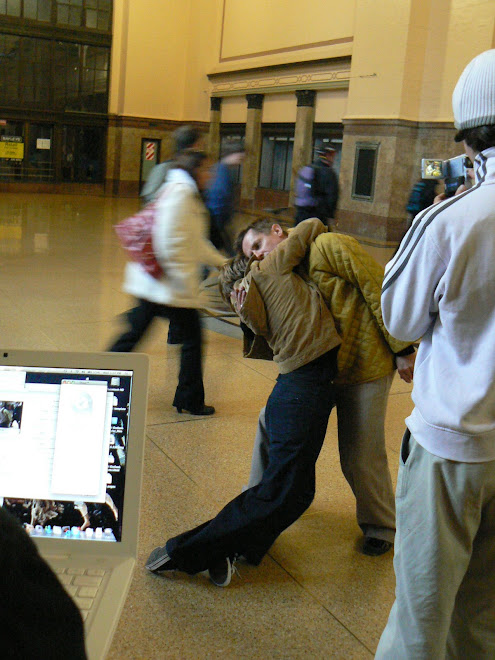
We also inhabited Wellington Railway Station. I wanted to time our occupation of spaces there with evening rush-hour to maximise the crowd potential in the spaces. Earlier in the day we explored the areas offering scope for the most dynamic and most subtle interaction. At 5.30pm I carried out several slow-rolls across the floor of the concourse foyer. I rolled from wall to wall, against the direction of crowd-flow to subtly increase the speed of the interactive movement taking place between us. I filmed through the crowd to catch glimpses of myself - those peripheral capture moments - and several other viewpoints. I am editing these to arrive at a composite roll-view. Pedestrian reaction was 90% focussed on train-catching - to be expected and indeed, sought after. 10% of walkers wanted to pause, turn, watch, speculate. No-one came to my 'aid'. In this location it was harder to hide the camera so there was probably more acceptance that what was taking place was a performance of some kind. All of these responses are positives as far as I am concerned, but require a careful rationale concerning the role of the camera in this project as a whole and the camera`s effect if recognized, at 'corpsing' or nullifying the intended dramas or tensions in the spaces.
We moved on to work in some of the linking under-pass passage-ways connecting platforms. I selected a meeting point of four passages and filmed our dance activity on the very edge of the crowd-presence. Body-distance away from the thoroughfare. I filmed Fiona from the top, moving very subtly at the bottom of stairs linking the street with the passages which meant that I had a dual view of above and below ground;
Night-time car break-lights, horizontal rain and gale-force winds whipping flax bushes in the swarming darkness set against subterranean flourescent lights and public moving swiftly past Fiona moving quirkily and very slowly. 'Are you all right?' came one query ...
A question of 'ownership': I have to ask myself, 'Is my practice meeting my conceptual intention?'
Because I am involved in an evolving, personal methodology/body of work, I will be making efforts to develop the theory/practice relationship to a point where my understanding of the material can allow me to assimilate the contextual information and make it my own. It is my voice that needs to be heard in this work and although to some extent I believe that it is emerging, there is a need for clearer processing-toward-ownership of my contextual influences to create a more robust and relevant bridge between the theoretical base and my practice.
After four days dancing and filming experimentally in July, my thinking has moved on.
Concept Aims:
In this work I wanted to carry out an investigation of moments of 'almost conversation', or 'just missed' dialogue with people on the street, to create within and through this discreet interaction, an environment which might allow discernible 'differences' in the respective identities between individuals to surface. Differences within unrelated identities - strangeness between strangers on the street and then from these 'almost meetings' operating as a catalyst, more subtly; differences within ourselves - the wider differences or strangeness between us and other people jogging a question that perhaps we ourselves may carry, co-habiting within us, both, our sure and 'certain' self and an uncertain, 'otherness'.
Locations:
To facilitate this process and consistent with my work carried out so far, I wanted to find a location which would allow me to identify and articulate visually as well as conceptually, notions of 'difference'.
Rhetorically and practically, this enquiry could be carried out almost anywhere. Descriptions of identity, as a notion is perhaps, infinitely portable: Domestically, with a stranger at the door; in a familiar suburb with interaction created between neighbours; Publicly, in the middle of a high street crowd. The composition of the physical environment is important to me and I am choosing to select interfaces between existing contrasting spaces at the edge of busy places and what could be termed, semi-redundant places; a 'littoral zone', which describes an inter-tidal space - a liminal place subject itself to the influence of a medium, the sea, continually passing across and potentially influencing and transforming the space. (Not to draw too literal a parallel between mediums, the movement of people in a city can be perceived as a fluid medium in acting out a time-based ebb and flow, capable of either sparsely populating or saturating spaces).
I want the familiar with the not-so-familiar, the place where a seldom used back-alley or service entrance meshes with a busy thoroughfare, because I mean to investigate the various tensions which can be found at these points: tensions through visually-contrasting movement-flow signatures - directional rush-hour crowd mass versus individual exploratory dance movement - the kind of ambiguous movement glimpsed in the distance (or right there, next to you) through a large, moving crowd of people which precipitates in one`s perception, a query; 'What was that I thought I saw? Or even, what 'strange' behaviour was that?'
I want to capture glimpses of tensions through difference, in spaces which themselves are almost forgotten and therefore liminal; urban-spaces perhaps aligned with my conceptual questions above: the conceptual differences apparent in what may constitute identity, the tensions between the path regularly trod and the one often seen from a distance but seldom traversed. As well as the 'idea' itself of partially-forgotten, semi-redundant spaces which are often only steps away from pedestrian trunk routes, I mean to enrol into the description of the identity of the place, the physical appearance and atmosphere, which may carry not just the crepuscular lighting, but also the memories and traces of past identities inherent in these kinds of places. Are these traces a kind of 'otherness'?
With the above needs in mind, I planned to move beyond Nelson to Wellington, which I saw as offering a broader range of locations which may be appropriate conceptually and physically for the work I wanted to explore.
On our way to Wellington City, my partner, Fiona Gilespie and I filmed a 'slow roll' in the restaurant on the Interislander ferry, the Kaitaki. On our arrival in Wellington we investigated possibilities for applying subtle interventionist dance strategies in Opera House Lane and Wellington Railway Station. (see vid clip on this post, above). In addition we carried out investigative, improvised dance on the walkway over the motorway from the Memorial Gardens and filmed crowd-flows and movements at selected sites on Lambton Quay. (This latter footage to be used for introducing crowd-presence in virtual world, Second Life projection)
I selected Opera House Lane as a location due to its proximity at the end of the lane to Courteney Place and Cuba Mall. At lunch times and rush hour, there is a considerable flow of people along the pavement, principally at right angles across the entrance to Opera House Lane. Pedestrians also use the lane itself, to cut through towards the harbour and veer off to go to the carpark half-way along the lane. We inhabited the lane for two hours, carrying out Authentic Movement-based experimental dance interspersed with Contact Improvisation Dance. The compositional space captured by camera was formalist in the sense that the camera was fixed on the ground for most of the duration, with a prescribed very linear perspective down the lane towards the main street, creating an extended depth of field. For this shot I wanted us to be a little removed from the entrance to use the atmospheric perspective qualities, looking out toward the lit entrance from the lane`s dark field with crowd-flow a little distant and in silhouette. I filmed Fiona from the street, walking past as a member of the public, with brief cut-aways into the lane entrance on my way past, to implant a snatched peripheral view a pedestrian might have of our activity as they carried on down the street. I subsequently edited/combined these two views to explore possibilities for non-linear narrative and a hand-held urgency to the video perspective. I also shot a danced view looking the other way down the lane to document the wider perspective within the space.
After reflection on the work carried out to date, I have identified the need to move my research focus. Hitherto, my research has been centred principally around information on the 'other' sourced from theorists like Georg Simmel, Jacques Derrida, Michel de Certeau, Emmanuel Levinas, Martin Heidegger, Marc Augé, Ian Buchanan, Mikhail Bakhtin and others. Because much of this is very dense, philosophical material I think it relevant to begin to locate some of the findings within more specific research relating to my concepts, dance practice as medium and the specific environments in/with which I am working.
Before I do this, I would like to offer short summaries I have made to aspects of selected theoretical texts which to some extent, may position these theorists in their stance toward the issue of identity. It is not my intention to 'skim' over these weighty sources, but to be as transparent as possible about the position of some of my thinking in relation to a very small part of their material on this subject, in an effort to gain some measure of clarity for myself.
What is the 'other'?
Emmanuel Levinas, (1906-1995) influenced by and perhaps pushing beyond the phenomenological methods and territories of Edmund Husserl and Martin Heidegger, located his studies in ethical, rather than ontological dimensions of otherness. Ethics for Levinas meant the importance for the individual in taking responsibility for self or 'I' through a responsibility to 'otherness' in the individual`s stance toward 'difference' - seeing an 'other' person in a face-to-face interaction, not so much as a reflection of oneself, but as simply different and above all, greater than oneself, ' ... I am responsible for the Other without waiting for reciprocity, were I to die for it. Reciprocity is his affair. It is precisely insofar as the relation between the Other and me is not reciprocal that I am subjection to the Other; and I am "subject" essentially in this sense. It is I who support all ... The I always has one responsibility more than all the others.'
Levinas stated in 'Entre nous: on thinking-of-the-other' (1998), (Entre nous, trans: 'Between us'), that 'Our relationship with the 'Other' is always a relationship with mystery'. This reference is to the cultural or ethnic 'other' rather than simply a stranger on the street and his position with regard to the 'other' was governed principally by a concern that if a being were to enter into a relation with the 'other', how would the self avoid being completely dominated and crushed? This is written from the reference to Levinas` perception of the 'other' which appears to have been orientated around aligning this state with that of death: 'So complete is the strangeness of the future of death that it renders the subject utterly immobile', therefore, 'it leaves him/her no longer able to be able' and in 'Totality and Infinity', (1969), p. 152, the 'other' is, '... Autochthonous, that is, rooted in what it is not, it is nevertheless, within this enrootedness independent and separated.' (from self).
In contrast to this, Martin Heidegger, in Being and Time Sein und Zeit, (1927) who coined the composite term Dasein, a holistic state of our fully occupying or 'being' in the world, suggested that Dasein was informed and empowered by the awareness of our impending death (another interpretation of 'other') and was therefore capable of changing us with the full potentiality of 'Being'. The existential and ontological constitution of the totality of Dasein - how it is manifest or realized, is grounded in temporality - in other words, Dasein recognizes otherness as indispensable to our corporeal self and is connects us to life 'in-the-world'.
Ian Buchanan, in 'Michel de Certeau, cultural theorist', (2000), discusses the term 'Heterology'. De Certeau was formulating a treatise on heterology but this was unfinished at the time of his death. Traditionally, heterology designates that branch of philosophy which is concerned with the 'other'. Buchanan suggests that philosophy relies on the study of the 'other' through heterology, yet still without being able to comprehend it. Buchanan quotes de Certeau: 'The 'other' besides being 'when', 'where', and 'what' I am not is also radically contiguous - so beyond the imagining that it does not even share a common border with the imaginable'.
Mikhail Bakhtin`s 'Law of placement' identifies, through seeing and vision, the 'other' as indispensable to the self. We rely upon the 'other' to map or affirm those areas on ourselves that we cannot see or easily sense - our own forehead, our ears, how we taste, etc ... Bakhtin asserts that, 'self means nothing without the alterity outsideness of the 'other'. 'I cannot become myself without another'.
For Jacques Derrida, 'heterology' is a pejorative - a naïve dream of empiricism - itself a 'non-philosophy' or reliable approach to informed learning. For Derrida, what might 'otherness' through the study of heterology look like? Buchanan tells us that it would have to be formulated as an alternative to, but not as a compromise between, in Derrida`s words: 'The impossibility of the infinitely 'other'; and the impossibility of an other that is not infinitely 'other' - as near a clear definition of 'otherness' as any that I have found to date. ('Michel de Certeau, cultural theorist' (2000)
The anthropologist, Marc Augé seeks to eliminate the problem within the debate entirely by suggesting that the self or 'same' be taken out of the equation: 'We are as 'other' to ourselves as we are to others - so our relation to ourselves is no different from our relation to others'.
Such are some of the boundaries of heterology within philosophical theory. The 'otherness' of the self may not be an identifiable personna or condition - it may manifest as a moment of recognition - it may be an entity - it may be a state, like Heidegger`s Dasein, of being; the not-I-in-me - in the world. It may be, after de Certeau, a map to a distant territory.
Because the nature of what heterology seeks to identify is clearly mysterious, I believe I need to explore my interpretations of the presence of the 'other' by using such 'indicators' as may be identifiable or recognizable in a given space and time. My practice then, is to seek ways to generate and document these indicators.
Georg Simmel`s dynamic of the 'host' and 'stranger' (see earlier posts) polarity still seems relevant, even though Simmel located this relationship within a specific context, time and place. Aspects of his concept of alterity offer a valid avenue of approach for me which, despite Derrida`s judgement above, could be appropriate as reference for my concepts if explored using experimental, documented empirical field-work (my dance/video practice) to record information. I need to ensure that my own research and development of concepts does not appropriate Simmel`s positioning. Ownership of my process is essential while I endeavour to locate myself within the framework of investigating identity in my specific time and place and the layers or personna with which it might be comprised.
Returning to my practice:
In Opera House Lane I was looking for small, fleeting connections between our dance begin to develop this as a 'language' or at least, as a vocabulary for tableaux that are essentially unspoken and how this might intervene and intersect with the language of crowd/individual pedestrians` movement, rhythms, patterns, travelling past us. I was not after in-depth, substantial meetings. I was interested in making ourselves available to catalyze ephemeral conversations, 'almost'-dialogue, brief encounters, micro-dramas with people who might glance our way, perceive us through a double-take moment - views between other moving people - perception 'slippage'. So our movement was divided between notions of Contact Improvisation conversations between our dueting selves and minimal, inferred connections with passers-by. In retrospect this became a compelling narrative in terms of mapping the space of Opera House Lane, but was inconclusive in its aim to connect in these 'almost-connections' with other people in the space. I had positioned us a little far down the lane to make the interaction with the crowd-flow on the main street meaningful, but the slightly distant, lit entrance appeared Michal Rovner-esque with blurred crowd-shapes coalescing and splitting, morphing and sliding away - interesting and partially addressing the distance perspectives I wanted, but still requiring a different focus for more intimate 'conversations' to take place. This meant that we were more dependent for the quality of interaction that I wanted to explore, upon those pedestrians who entered the lane and passed close to us, so the contrast between our idiosyncratic movement signatures and that of a dense crowd-flow was not signifcant at this location.
We shared fleeting eye-contact and double-takes with cyclists, runners, men on crutches, businessmen and women, shoppers, families with children, concerned people who wanted to give us food and drink - or call for an ambulance - and we had to avoid the odd car using the lane as a shortcut. Our movement explored levels of alterity or 'otherness' within our own dance, but also the terrain of the lane: Semi-avoidance of fast and slow-moving vehicles, giving weight to existing 'furniture', slow-rolling and running across the widths of the space, filming the slow-roll from the roller`s perspective and as mentioned above, filming the pedestrian`s view of us from the street walk-by. Most people effected polite distance with peripheral views and some managed a cursory head-turn or pause. Muted indifference oscillating between curiosity and surprise. We possessed 'stranger' traits as entities in the realm of pedestrian 'host' familiarity with the geography and their known feel of the place.
At times this role was too obviously overt.
The camera was concealed at Opera House Lane which provided candid perspectives of the public using the space and so did not colour or influence their perception of our reasons for being in the space.
We also inhabited Wellington Railway Station. I wanted to time our occupation of spaces there with evening rush-hour to maximise the crowd potential in the spaces. Earlier in the day we explored the areas offering scope for the most dynamic and most subtle interaction. At 5.30pm I carried out several slow-rolls across the floor of the concourse foyer. I rolled from wall to wall, against the direction of crowd-flow to subtly increase the speed of the interactive movement taking place between us. I filmed through the crowd to catch glimpses of myself - those peripheral capture moments - and several other viewpoints. I am editing these to arrive at a composite roll-view. Pedestrian reaction was 90% focussed on train-catching - to be expected and indeed, sought after. 10% of walkers wanted to pause, turn, watch, speculate. No-one came to my 'aid'. In this location it was harder to hide the camera so there was probably more acceptance that what was taking place was a performance of some kind. All of these responses are positives as far as I am concerned, but require a careful rationale concerning the role of the camera in this project as a whole and the camera`s effect if recognized, at 'corpsing' or nullifying the intended dramas or tensions in the spaces.
We moved on to work in some of the linking under-pass passage-ways connecting platforms. I selected a meeting point of four passages and filmed our dance activity on the very edge of the crowd-presence. Body-distance away from the thoroughfare. I filmed Fiona from the top, moving very subtly at the bottom of stairs linking the street with the passages which meant that I had a dual view of above and below ground;
Night-time car break-lights, horizontal rain and gale-force winds whipping flax bushes in the swarming darkness set against subterranean flourescent lights and public moving swiftly past Fiona moving quirkily and very slowly. 'Are you all right?' came one query ...
A question of 'ownership': I have to ask myself, 'Is my practice meeting my conceptual intention?'
Because I am involved in an evolving, personal methodology/body of work, I will be making efforts to develop the theory/practice relationship to a point where my understanding of the material can allow me to assimilate the contextual information and make it my own. It is my voice that needs to be heard in this work and although to some extent I believe that it is emerging, there is a need for clearer processing-toward-ownership of my contextual influences to create a more robust and relevant bridge between the theoretical base and my practice.
Thursday, 5 July 2007
Investigating notions of identity in Contact Improvisation Dance practice
I am a relative new-comer to Contact Improvisation Dance, (I shall use the initials CI from now on) having been engaged in practice and teaching for eight years now. The questions I raise here are therefore from a desire to inform myself and further my understanding of CI. I would like also to encourage informed debate for all and the sharing of thoughts on certain aspects which may be inherent within the nature of the dance, which relate specifically to the notions surrounding the title of this post: 'The self and 'other' in Contact Improvisation Dance practice'.
If one takes as a basic premise for Contact Improvisation Dance the idea and practice of two (or more) people connected through not only a diverse repertoire of listening through touch/weight-giving and receiving, but also through an active mutual sharing of intent - the intent to reach out both physically and conceptually - to be actively inquisitive - I would like to suggest that the nature of the physical, emotional, somatic and psychological conversation(s) taking place are influenced by and perhaps even driven by states present in each of us, of what I shall term, 'host'/self and 'stranger'/other roles or identities.
This descriptor 'host' and 'stranger' was first implemented by Georg Simmel in his 1908 essay, 'The Stranger'. The words suggest a desire to communicate the often, incommunicable. Simmel used these words in two contexts: The first context located the 'other' in urban society in a place which was and still is, understood by us - each of us, as 'host' identities, at home and comfortable on our own ground. Often, in this context, the 'other' has a capital 'O' signifying ethnical difference and is often associated with attitudes and stances which are prejudicial to and biassed against a fair perspective of that other person. Still in the same context, the term, 'stranger' can be used to describe simply, the 'person-you- have-never-met-before in the street' - an 'unknown' entity and in so doing, unconsciously we locate ourselves as 'hosts' within this scenario. It should be acknowledged of course, that the person you have just met will equally (unconsciously) and with just as much validity, consider themselves to be 'host' to their schema of the world which is not unknown, where you are the stranger.
However, in the second scenario the term 'other' can also be used to describe that 'otherness' within yourself. That part of you that perhaps you are not sure that you know too much about. That part of you that sometimes takes you by surprise. The part of you which may put you out in an instinctive, limbic region and the part of you with which you can sometimes converse when you are listening adequately - to this 'other' in yourself. So there is the notion here that in fact, you yourself can be that person that you meet in the street - and be the stranger.
On one level to partner someone in a CI duet is a simple undertaking. But I believe there are layers which materialize and evaporate around the success of being in the moment where there is only the moment - layers of feeling, observation, appraisal, self-doubt, elation, concentration on not doing any of these things ...
which constantly move and replace and replace and replace one another within the dance. I am wondering to what extent these layers are generated by the self/host and stranger/other dynamic within us and outside us as we somatically read ourselves and symbiotically read our partner?
Are we alone when we solo? Authentic Movement as a vehicle for self-regulatory enquiry teaches us, I would suggest, that we are often not 'alone'. We talk to ourselves. If CI can be seen as a fractal of 'life', then as in life where we are sustained and the world around us is re-inforced by our internal dialogue so we oscillate between 'being' and talking to ourselves in the dance. Existentially listening in the moment in a duet, often the internal dialogue is stilled, so perhaps negating that presence of the self/host and other/stranger in our personna within the dance.
Do we move in and out of self and 'other' roles in the dance? Or are we too busy listening to our partner - being in the moment, for this distinction to be recognized or indeed, realized? The nature of improvisation is such that improvising as a process creates holes or impasses or interfaces between doing and not-doing. Does our attention focus during these moments, away from our partner and back to us? Can we be conscious, during these moments, of our internal conversation as well as the one we are having with our partner?
I am inclined to the belief that in fact, all CI encounters are 'successful' as events in themselves, whatever the outcome, (within reason) in the sense that they foster liminal dance experiences, narratives of the unexpected. Like so many dancers, I have danced unexpected dances with a variety of people; with Argentinians in Sydney and with Americans in New Zealand Aotearoa, but of course, equally, every dance with an established friend is a foray into uncharted territory. Recently, I had someone I had never met before approach me to duet and cordially, I asked, 'How are you feeling today?' The response was, 'Come and find out', a not uncommon yet extremely evocative invitation to come and collide gently with the unknown and in so doing, to 'find out' not through being told but through the process - and it is a process - of simply engaging with .... a stranger.
CI creates an expression of and a desire for collaboration - with strangers. CI also provides us with the tools to negotiate this uncertain terrain and manage the encounter using perhaps the most profoundly-simplest of strategies; that is by the desire and through the facility to listen. The mutually-collaborative voice occurs only after one learns how to listen. It makes of us all, open learners. I believe the conversation which then develops is negotiated through a mutual honouring and acceptance of difference. The difference manifested in the encounter by the host in each of us, a tacit acceptance of the stranger in us and the existence of both in the partner in the duet.
If one takes as a basic premise for Contact Improvisation Dance the idea and practice of two (or more) people connected through not only a diverse repertoire of listening through touch/weight-giving and receiving, but also through an active mutual sharing of intent - the intent to reach out both physically and conceptually - to be actively inquisitive - I would like to suggest that the nature of the physical, emotional, somatic and psychological conversation(s) taking place are influenced by and perhaps even driven by states present in each of us, of what I shall term, 'host'/self and 'stranger'/other roles or identities.
This descriptor 'host' and 'stranger' was first implemented by Georg Simmel in his 1908 essay, 'The Stranger'. The words suggest a desire to communicate the often, incommunicable. Simmel used these words in two contexts: The first context located the 'other' in urban society in a place which was and still is, understood by us - each of us, as 'host' identities, at home and comfortable on our own ground. Often, in this context, the 'other' has a capital 'O' signifying ethnical difference and is often associated with attitudes and stances which are prejudicial to and biassed against a fair perspective of that other person. Still in the same context, the term, 'stranger' can be used to describe simply, the 'person-you- have-never-met-before in the street' - an 'unknown' entity and in so doing, unconsciously we locate ourselves as 'hosts' within this scenario. It should be acknowledged of course, that the person you have just met will equally (unconsciously) and with just as much validity, consider themselves to be 'host' to their schema of the world which is not unknown, where you are the stranger.
However, in the second scenario the term 'other' can also be used to describe that 'otherness' within yourself. That part of you that perhaps you are not sure that you know too much about. That part of you that sometimes takes you by surprise. The part of you which may put you out in an instinctive, limbic region and the part of you with which you can sometimes converse when you are listening adequately - to this 'other' in yourself. So there is the notion here that in fact, you yourself can be that person that you meet in the street - and be the stranger.
On one level to partner someone in a CI duet is a simple undertaking. But I believe there are layers which materialize and evaporate around the success of being in the moment where there is only the moment - layers of feeling, observation, appraisal, self-doubt, elation, concentration on not doing any of these things ...
which constantly move and replace and replace and replace one another within the dance. I am wondering to what extent these layers are generated by the self/host and stranger/other dynamic within us and outside us as we somatically read ourselves and symbiotically read our partner?
Are we alone when we solo? Authentic Movement as a vehicle for self-regulatory enquiry teaches us, I would suggest, that we are often not 'alone'. We talk to ourselves. If CI can be seen as a fractal of 'life', then as in life where we are sustained and the world around us is re-inforced by our internal dialogue so we oscillate between 'being' and talking to ourselves in the dance. Existentially listening in the moment in a duet, often the internal dialogue is stilled, so perhaps negating that presence of the self/host and other/stranger in our personna within the dance.
Do we move in and out of self and 'other' roles in the dance? Or are we too busy listening to our partner - being in the moment, for this distinction to be recognized or indeed, realized? The nature of improvisation is such that improvising as a process creates holes or impasses or interfaces between doing and not-doing. Does our attention focus during these moments, away from our partner and back to us? Can we be conscious, during these moments, of our internal conversation as well as the one we are having with our partner?
I am inclined to the belief that in fact, all CI encounters are 'successful' as events in themselves, whatever the outcome, (within reason) in the sense that they foster liminal dance experiences, narratives of the unexpected. Like so many dancers, I have danced unexpected dances with a variety of people; with Argentinians in Sydney and with Americans in New Zealand Aotearoa, but of course, equally, every dance with an established friend is a foray into uncharted territory. Recently, I had someone I had never met before approach me to duet and cordially, I asked, 'How are you feeling today?' The response was, 'Come and find out', a not uncommon yet extremely evocative invitation to come and collide gently with the unknown and in so doing, to 'find out' not through being told but through the process - and it is a process - of simply engaging with .... a stranger.
CI creates an expression of and a desire for collaboration - with strangers. CI also provides us with the tools to negotiate this uncertain terrain and manage the encounter using perhaps the most profoundly-simplest of strategies; that is by the desire and through the facility to listen. The mutually-collaborative voice occurs only after one learns how to listen. It makes of us all, open learners. I believe the conversation which then develops is negotiated through a mutual honouring and acceptance of difference. The difference manifested in the encounter by the host in each of us, a tacit acceptance of the stranger in us and the existence of both in the partner in the duet.
Wednesday, 4 July 2007
Dance Exploration in Mixed Realities? Investigating Second Life as a virtual platform for duality within identity.
One of the strands of my research for In the Company of Strangers is currently investigating the nature of 'virtual' or 'not-real' moments, how we perceive or witness them and move in and out of the real or virtual in both Real Life and in the virutal world of Second Life, ('Second Life. com'). At the moment I am experimenting with uploading real-life film of my dance work into Second Life and projecting this against selected surfaces in virtual urban environments and conversely, exporting footage of my dance work in Second Life to project onto selected surfaces in urban environments in real life.
Mark Hansen, in Bodies in Code, (2006) sees the embodiment of function manifesting through the human body, acting as a kind of seismographic wand - ‘ a vehicle of being in the world’ (Hansen, 2006:5-6 after Heidegger). He maintains that: ‘All virtual reality is mixed reality … all reality is mixed reality’, (Hansen, 2006:5-6) Hansen quotes Massumi who talks about the existence of the analogue as a transformative entity:
"Always on arrival a transformative feeling of the outside, a feeling of thought” sensation is the being of the analog. (sic) This is the analog in a sense close to the technical meaning, as a continuously variable impulse or momentum that can cross from one qualitatively different medium into another. Like electricity into sound waves. Or heat into pain, Or light waves into vision. Or vision into imagination. Or noise in the ear into music in the heart. Or outside coming in. Variable continuity across the qualitatively different: continuity of transformation.' (Massumi, Parables for the Virtual ... 2002:135 ) Like Real into 'Second Life' and back and ...
Through our internal analogue therefore, we possess the innate capacity, to transform, continuously, the many real and virtual realities with which our existence is constructed and constantly deconstructed, reconstructed and re-affirmed.
The mixed-reality paradigm can shift the fields of 'orthodox' perceptions (has perception, in fact, ever been orthodox?) which have, in the past, established existing modes of seeing and understanding reality: Cinema has hitherto been granted the capacity to represent the world from a non-human (this is debatable in the sense that if the footage was the product of human creation, that is the unassailable baseline from which all the forms of expression within the presented film stem), perspective and so is properly mechanistically autonomous from direct human influence; in contrast to this, the process within us as humans which brings virtual reality technologies together with our natural perceptions, supports a function which expands the scope of our natural perception and integrates real-world and virtual realities to arrive at a more homogeneous, mixed reality. Rather than presenting the virtual as a completely technical simulacrum – a portal to a fully immersive, separate or fantasy world, the mixed-reality paradigm regards it as just one more realm among others which can be accessed through our already embodied perception or our ability to enact - or, in the case of both First and Second Life, role-play.
So there is less emphasis here on the content and more emphasis on the ways in which we access that content.
In the light of the above, I am interested in pursuing this definition of mixed-reality - a 'new' realization of the fluidity of experiencing simulacra: In the first instance, physically/perceptually moving in and out of real and virtual moments in Real Life (RL in Second Life speak) and in the second instance, physically/perceptually, in front of our computer, moving in and out of Real Life (one is tempted to use the term First Life ...) and Second Life. I am inclined to the feeling that there is little difference between these two scenarios. They are not so much distinct from one another as examples of layered mixed-reality encountered within the moment. I think that the two realities are actually 'one': they can be seen and experienced first- hand as mutually-dependent, opposing binaries and therefore as a linked whole or a single, layered experience. So for me, the virtual and real in our lives can be described, like so many aspects in our lives, as states of perceptual layering-in-flux.
It can be said perhaps, in part, that in urban environments these days we are, all of us, strangers or at least, that the stranger among us is alive and well. The mixed-reality platform of Second Life/Real Life as a 'place', lends itself constantly to the process of host and stranger interaction and the assuming of both roles. I am curious to see how I may be able to apply this to my dance movement in and out of Real and Second Life, using the process of activation to manipulate and modify partially-peopled 'non/places'.
Mark Hansen, in Bodies in Code, (2006) sees the embodiment of function manifesting through the human body, acting as a kind of seismographic wand - ‘ a vehicle of being in the world’ (Hansen, 2006:5-6 after Heidegger). He maintains that: ‘All virtual reality is mixed reality … all reality is mixed reality’, (Hansen, 2006:5-6) Hansen quotes Massumi who talks about the existence of the analogue as a transformative entity:
"Always on arrival a transformative feeling of the outside, a feeling of thought” sensation is the being of the analog. (sic) This is the analog in a sense close to the technical meaning, as a continuously variable impulse or momentum that can cross from one qualitatively different medium into another. Like electricity into sound waves. Or heat into pain, Or light waves into vision. Or vision into imagination. Or noise in the ear into music in the heart. Or outside coming in. Variable continuity across the qualitatively different: continuity of transformation.' (Massumi, Parables for the Virtual ... 2002:135 ) Like Real into 'Second Life' and back and ...
Through our internal analogue therefore, we possess the innate capacity, to transform, continuously, the many real and virtual realities with which our existence is constructed and constantly deconstructed, reconstructed and re-affirmed.
The mixed-reality paradigm can shift the fields of 'orthodox' perceptions (has perception, in fact, ever been orthodox?) which have, in the past, established existing modes of seeing and understanding reality: Cinema has hitherto been granted the capacity to represent the world from a non-human (this is debatable in the sense that if the footage was the product of human creation, that is the unassailable baseline from which all the forms of expression within the presented film stem), perspective and so is properly mechanistically autonomous from direct human influence; in contrast to this, the process within us as humans which brings virtual reality technologies together with our natural perceptions, supports a function which expands the scope of our natural perception and integrates real-world and virtual realities to arrive at a more homogeneous, mixed reality. Rather than presenting the virtual as a completely technical simulacrum – a portal to a fully immersive, separate or fantasy world, the mixed-reality paradigm regards it as just one more realm among others which can be accessed through our already embodied perception or our ability to enact - or, in the case of both First and Second Life, role-play.
So there is less emphasis here on the content and more emphasis on the ways in which we access that content.
In the light of the above, I am interested in pursuing this definition of mixed-reality - a 'new' realization of the fluidity of experiencing simulacra: In the first instance, physically/perceptually moving in and out of real and virtual moments in Real Life (RL in Second Life speak) and in the second instance, physically/perceptually, in front of our computer, moving in and out of Real Life (one is tempted to use the term First Life ...) and Second Life. I am inclined to the feeling that there is little difference between these two scenarios. They are not so much distinct from one another as examples of layered mixed-reality encountered within the moment. I think that the two realities are actually 'one': they can be seen and experienced first- hand as mutually-dependent, opposing binaries and therefore as a linked whole or a single, layered experience. So for me, the virtual and real in our lives can be described, like so many aspects in our lives, as states of perceptual layering-in-flux.
It can be said perhaps, in part, that in urban environments these days we are, all of us, strangers or at least, that the stranger among us is alive and well. The mixed-reality platform of Second Life/Real Life as a 'place', lends itself constantly to the process of host and stranger interaction and the assuming of both roles. I am curious to see how I may be able to apply this to my dance movement in and out of Real and Second Life, using the process of activation to manipulate and modify partially-peopled 'non/places'.
Sunday, 1 July 2007
Saturday, 30 June 2007
Subscribe to:
Posts (Atom)