The Mythology of Leaving
I am currently examining the makeup and characteristics of departure or leaving a conversation or meeting in the street. So far in this project I have begun to explore philosophical (some may say ‘real’) theories dealing with notions of ‘becoming’ and change (H. Bergson, B. Massumi and L. Lye) and latterly, ways in which our meetings with people may be governed by the inexorability of departures underpinning our lives. Perhaps I am promulgating a myth here. The mythology of ‘Leaving’ as an event in itself, which continually draws us away through a changing field from one apparently settled point of fixture to the next. Meetings with others, I see as points of purchase in the torrent of change in which we are immersed.
To develop a clearer understanding of the phase of ‘leaving’ it seems to me important to investigate what makes up the other phases of the process of connecting with someone: Arrival and maintenance of the meeting. To do this we can consider the modes of speech employed in the meeting, with content covered in books like the one mentioned in my last post, The ART OF SPEAKING Made Simple, Gondin, R. Ph D and Mammen, W. Ph D. W.H. Allen London 1967 or more contemporary publications on how to converse and ‘hold a conversation. However there are more subtle forces at work here than cultural codes of politeness, good manners, when and how to use inflection and appropriate, clear, well enunciated speech in public places.
Protoconversation
‘Rudimentary engagements, communication at its most basic, the prototype of all human interaction …’ such are the descriptors for the term, ‘Protoconversation’ in Daniel Goleman`s, Social Intelligence, The New Science of Human Relationships, Bantam Books 2007 (p.36).
The term relates to the early neural signals which expand into methods for establishing a rapport that we experienced as babies, making our first communicative forays into the outside world through the medium of our mothers. In fact, the term goes further back than this, describing those aspects of the mother and foetus relationship which concern their shared, internal conversations – micro dialogues managed osmotically in response to everything from the mother rolling over at night (who disturbed whom?) to the growing baby`s response to external sounds like human voices or laughter.
These intimate interactions between mother and child, whether pre or post birth are largely non-verbal, usually resorting to words for their sound values, rather than literal meanings. The greater part of the communication is carried out through touch, gaze and tone of voice. According to Goleman, the sounds emitted by the mother (usually quite high in pitch, technically, around 300hertz) deploy prosody, melodic overtones of speech that transcend culture, making it irrelevant whether the sounds are made from a Spanish or Mandarin, English or Urdu basis.
Often a synchrony of rhythmic motion, touch, gaze, sound and breath, a coordination of hand movements and facial expressions will establish a mutual rapport between mother and child. Such conversations are more often than not very short in duration – even only seconds in length and they end when both parties arrive at matched states, typically, affectionate ones. So we have a synchronized duet culminating in a mutually-agreed place of temporary departure. Goleman cites the developmental psychologist and the world`s leading specialist in protoconversation at the University of Edinburgh, Colwyn Trevarthen. Trevarthen describes the findings from his scientific studies (made painstakingly through the analysis of many hours of videotaped footage) as duets where both performers, “seek harmony and counterpoint on one beat to create a melody”.
Protoconversations have a certain elasticity in meaning and application. Not only does it refer to the very earliest development of our powers of communication (mostly non-verbal), where it could be said that the baby is undergoing a kind of tutorial in successful interaction, but we can also extend this to a more mature development occuring in the daily interactions we experience as adults (the tutorial goes on).
In adulthood, protoconversations remain as our most fundamental template for mapping, matching or missing in meetings with others. The template is tacit, a subtle awareness through feeling and the senses which allows us when we meet to quietly proceed, in step, with a stranger or acquaintance, friend or family member. Protoconversation is a silent dialogue – Goleman uses the term, ‘substrate’ (p.37) upon which all encounters or engagements are built. Goleman assures us that it is, ‘… the hidden agenda in every interaction’. (p.37). I would tend to say rather than ‘agenda’, that protoconversations are the underlying adhesive which allows us to empathize or literally in the case of CI dance, to come together in ways which are meaningful – without a word being said.
So protoconversation is for all of us, a support system. A silent go-between if you will, which underpins and as a mode of communicating, often outlasts (those comfortable – or uncomfortable silences) the manifestation of speech.
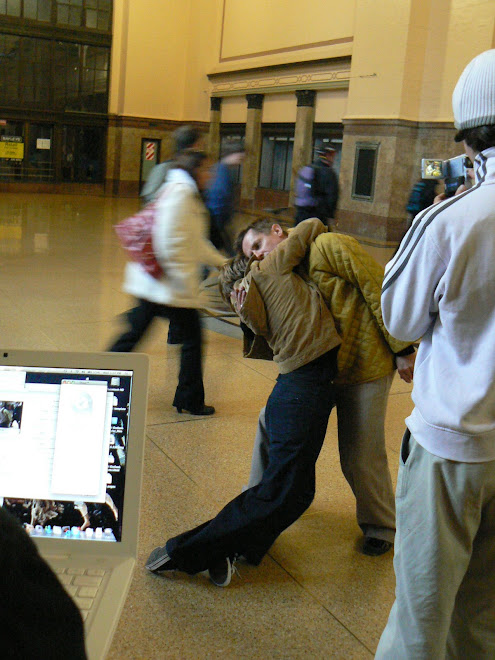
Clearly, for those of us who are Contact Improvisation (CI) dancers, there are some alignments to be pursued here. Without being glib, one could say that the earliest engagements through protoconversations are examples of contact improvisation. In CI dance, speech is seldom used (but can be), music is not employed as a score to be followed or ‘danced to’ although sound is used as a collaborative medium, group ‘discussions’ are frequently explored in CI dance but more often than not as a kinesthetically based dialogue, the CI dance is realised as a duet between two people. One could extend this to say that the duet is a neurokinetic conversation supported by mutual empathy - and curiosity about the path ahead. Attention, albeit one that fluctuates, is paid to the task of listening to one`s partner, in the moment, using protoconversation tools: When ‘conversing’ in the duet, listening - paying attention through touch to the tone or tenor of the connection with the other person, the unspoken, fleetingly glimpsed under-dialogue of the-moment-in-change is not only paramount if the duet is to last, but it also allows us to gather information about what is occuring in front of us on Goleman`s ‘substrate’ level.
So what occurs when the duet finishes? Why do people walk away? What cues are there to warn of impending closure? In CI, as in a spoken conversation between two people, sometimes one person leaves; sometimes there is a tacit, unspoken moment when both parties recogize that a point of stasis has been reached and closure is imminent. This may be the result of a mismatch in listening, a change in mood, a point when there is a mutual recognition that both bodies have ‘had enough’. Sometimes the narrative which has been self-sustaining, evolving, fluctuating through pauses (which are not in themselves necessariliy inert) and bursts of intense movement, simply runs out of momentum and finds its own place to rest. The dancers are not only instigators of this but simultaneously, witnesses to it.
However the pathway unfolds, dancers tend to adopt a philosophical attitude toward the process of leaving the duet. For myself, there is rarely a sense of failure or of having done something ‘wrong’ when I close with a partner. The experience tends to be governed by the moments shared. The leaving is as much a part of the dance as the arrival and the ‘body’ of the dance itself.
In the wider context of the street, leaving frees us up for the next event in our lives. In a circle or ‘round robin’ (where everyone is free at any time, to select a partner of their choice from the circle) of CI dancers, after several dances you become adept at leaving, as you do at arriving in the next duet. For me, the first minutes of a duet are always redolent with that feeling of encountering something new – mapping hitherto uncharted territory. An open stance in body and mind is helpful, as is this stance when leaving which enables one to move away unscathed from past moments.
Is it possible that protoconversation tools and processes equip us also to leave a given connection they have so assiduously wrought? Or do we simply assume the mantle of autonomy without company? That there are other skillsets and strategies for this is beyond the scope of this project. Suffice it to say, I believe that ‘Leaving’ requires practice. My over-riding feeling is that we are swept on regardless, in a stream of change that we cannot prevent and only rarely, delay.
‘Leaving’ is a descriptor of this state which accompanies us so that departure itself becomes our companion. ‘Leaving’ ensures that we are forever in the company of strangers.
Friday, 25 April 2008


Wednesday, 23 April 2008
Leaving
Indeterminacy and the roaming body; Leaving – ‘a non-present potential to vary’ - moving away from points of purchase.
‘The best of conversations must end. Start to go before the other fellow takes out his watch, don`t dawdle over the coats and avoid starting conversations at the door. Pay your respects briefly and go. Ending a conversation is also a way of keeping one going … ' The ART OF SPEAKING Made Simple, William R. Gondin, Ph.D and Edward W. Mammen, Ph.D. Made Simple Books, W.H. Allen London, 1967
The above extract hails from a text introducing the art of making conversation in the 1960s. Has the art changed? The notion of ‘leaving’ I believe, is timeless.
The forward by James Dodding for this book informs us that, ‘Speech is the most important means of communication people have with one another and it is essential to be able to use it fluently, effectively and with confidence. It is equally essential, both professionally and socially, to know what is appropriate to the occasion – what to say, when to say it and how to say it.’
Undeniably, speech is central to the fluidity of our existence in the human world in everyday life. Not only does speech aid our functioning effectively in social situations and locates us in time and given space, but more candidly, the ability to converse and to be heard affirms, empowers and expands the map of the human heart. Speech comprises much of the articulation of this and that of our wider socio-contextual map - much, but not all. The unwritten text in the above quotation; the hidden message which is about when and how to leave an engagement is articulated through speech-prompts but also through body language, fluctuating heart rate and eye blinking - an underlying empathetic cue to move on with this decision coming from a somatic place ‘of ‘ and in the body – a place contextualized by a proxemic* imperative and a place from which, in a manner of speaking (no pun intended) we have already departed.
In Tricks of the Mind, Channel 4 Books 2007, by Derren Brown, under the section on ‘Targeted Rapport’ p.186 Brown writes, ‘ Most people when they are getting on well, will be in a state of unconscious ‘rapport’. They will tend to mirror each other`s body language and so on without realizing it …’ At the same time, ‘… there is the odd sensation we have all experienced (though we never think to mention it) of knowing when the other person is about to get up and leave. Suddenly there is something in the air, a moment or a shift and then you know the other person is about to say they should ‘make a move’. And if they don`t you have that feeling that they are outstaying their welcome’. The level of unconscious rapport experienced up to that moment, particularly if the conversation has lasted for some time, is responsible for the sharing of mutual thought and body patterns so that together you can sense when the time to leave has arrived.
Brown maintains that studies carried out on rapport have shown an array of mirrored behaviours that are not merely body positioning but something far more subtle.
It has been established that people in rapport with one another tend to breathe at the same rate, adopt similar facial expressions, blink at the same rate and use one another`s language. I would tend to describe these responses as somatically based. In other words they are products of a non-spoken, internal discourse that the body carries out continually (using one another`s language is still instigated by a bodily response to a stimulus). A hidden dialogue with the externally projected speech and vision through which we are more overtly governed.
In Social Intelligence, Bantam Dell 2007 under a Recipe for Rapport p.30, Daniel Goleman insists that we coordinate with one another most strongly through subtle, non-verbal channels like the ‘pace’ and ‘timing’ of a conversation and through the use of our body movements. People in rapport Goleman tells us, are animated, freely expressing their emotions, ‘… their spontaneous, immediate responsiveness has the look of a closely choreographed dance, as though the call-and-response of the interaction has been purposefully planned. Their eyes meet and their bodies get close … they are comfortable with silences.’ Equally, Goleman points out that, ‘Lacking coordination, a conversation will feel uncomfortable, with mistimed responses or awkward pauses. People fidget or freeze. Such mismatches torpedo rapport.’
Goleman asserts that social psychologists have found repeatedly that the more two people make ‘coupled moves’ that is, unorchestrated, simultaneous movements through empathy governed by natural tempo, the more positive their experience of the meeting will be: ‘If you watch two friends talking from a distance where you can`t hear what they`re saying, you can better observe this non-verbal flow: an elegant orchestration of their movements, smooth turn-taking, even coordination of gazes …’ A silent dance.
Below, in the short video clip, ‘Leaving – ‘a non-present potential to vary’ 3, (Sunday, April 20, 08) the couple under the spotlight conduct an animated and pleasant conversation in the street. Without being privy to their dialogue, we have no way of knowing what it is they are talking about. We could speculate, but this holds no interest for me. I am interested in their body language, their proximity to one another, the signals they unconsciously transmit about the way they are feeling with regard to their engagement with one another and how this evolves through the duration of the meeting. We cannot measure as their conversation unfolds, matures and gradually ends, either their heart rates, their blink reflexes or their breathing to identify changes in the body. These as we know, are responses to changes in the tenor of their connection, prompting in this case an impending movement away from one another, but perhaps while we can understand the theory of what may create this dynamic, without knowing the details we can witness the small drama from afar.
Without being at all judgemental of the behaviour of these two people (coincidentally I have met one of them) if I apply an objective appraisal (arrived at very subjectively) to their situation, it seems to me that if I look carefully at the last minute prior to their separating, although the woman eventually says goodbye, physically walks away and leaves the engagement, the man appears to have already departed from the conversation. He shuffles, he checks his cell phone, he hides behind his hands, he waves his arms uncertainly and looks around. He checks his watch. Eye contact decreases. No longer is he fully present. When she does finally leave, his reaction is one of marginal interest – because he is already no longer fully engaged. His ‘Leaving’ has crept into and hijacked the meeting while they were still talking.
Now, there is nothing unusual in this meeting. It is friendly, a range of communication (both verbal and physical) has occurred and it seems that a mutually agreeable outcome has resulted. The tenor of the conversation as a whole I would describe as quite neutral. Neither party invested too much emotion in the exchange, (this is a guess because I could not hear their conversation – sometimes physical actions can be kept in check in public places therefore belieing the true nature or substance of a meeting) neither was the exchange what I would call intimate; a scenario simply involving two people chatting on the pavement in their lunch-break. So one could also say that, without knowing what was said, there appears to be an absence of poignancy or pathos in the engagement. There is no consuming sense of sadness evident in their parting. It is quite business-like, although I am left with a sense that the woman was more engaged than the man.
Nevertheless, I am interested in what I see as the drama inherent within the meeting. The initial mutual focus on one another which existed, which then developed and altered as time passed. (I filmed this meeting for 15 minutes). I am interested in the quiet drama in the dynamic of leaving which took place, in two different forms. Both people left - movement away occurred in different ways, even though one of them stayed behind.
Indeterminacy and the roaming body – we have no way of knowing how things will go when we meet someone in the street. Somehow though, without always acknowledging it, in some form or another we are always leaving. The only non-variable is our non-present potential to vary – always moving away from meetings which themselves constitute places of temporary purchase within change.
To remind myself I quote Henri Bergson again: ‘… rather than there being things which change’ more accurately speaking, there is, ‘… change provisionally grasped as a thing’. Bergson, H. Visualizing Experience, Henri Bergson on memory in Middleton, D and Brown, S. D. 2005 p.62
*Proxemics: def - Anthropologist Edward T Hall 1959. See Wikipedia and other refs.
‘The best of conversations must end. Start to go before the other fellow takes out his watch, don`t dawdle over the coats and avoid starting conversations at the door. Pay your respects briefly and go. Ending a conversation is also a way of keeping one going … ' The ART OF SPEAKING Made Simple, William R. Gondin, Ph.D and Edward W. Mammen, Ph.D. Made Simple Books, W.H. Allen London, 1967
The above extract hails from a text introducing the art of making conversation in the 1960s. Has the art changed? The notion of ‘leaving’ I believe, is timeless.
The forward by James Dodding for this book informs us that, ‘Speech is the most important means of communication people have with one another and it is essential to be able to use it fluently, effectively and with confidence. It is equally essential, both professionally and socially, to know what is appropriate to the occasion – what to say, when to say it and how to say it.’
Undeniably, speech is central to the fluidity of our existence in the human world in everyday life. Not only does speech aid our functioning effectively in social situations and locates us in time and given space, but more candidly, the ability to converse and to be heard affirms, empowers and expands the map of the human heart. Speech comprises much of the articulation of this and that of our wider socio-contextual map - much, but not all. The unwritten text in the above quotation; the hidden message which is about when and how to leave an engagement is articulated through speech-prompts but also through body language, fluctuating heart rate and eye blinking - an underlying empathetic cue to move on with this decision coming from a somatic place ‘of ‘ and in the body – a place contextualized by a proxemic* imperative and a place from which, in a manner of speaking (no pun intended) we have already departed.
In Tricks of the Mind, Channel 4 Books 2007, by Derren Brown, under the section on ‘Targeted Rapport’ p.186 Brown writes, ‘ Most people when they are getting on well, will be in a state of unconscious ‘rapport’. They will tend to mirror each other`s body language and so on without realizing it …’ At the same time, ‘… there is the odd sensation we have all experienced (though we never think to mention it) of knowing when the other person is about to get up and leave. Suddenly there is something in the air, a moment or a shift and then you know the other person is about to say they should ‘make a move’. And if they don`t you have that feeling that they are outstaying their welcome’. The level of unconscious rapport experienced up to that moment, particularly if the conversation has lasted for some time, is responsible for the sharing of mutual thought and body patterns so that together you can sense when the time to leave has arrived.
Brown maintains that studies carried out on rapport have shown an array of mirrored behaviours that are not merely body positioning but something far more subtle.
It has been established that people in rapport with one another tend to breathe at the same rate, adopt similar facial expressions, blink at the same rate and use one another`s language. I would tend to describe these responses as somatically based. In other words they are products of a non-spoken, internal discourse that the body carries out continually (using one another`s language is still instigated by a bodily response to a stimulus). A hidden dialogue with the externally projected speech and vision through which we are more overtly governed.
In Social Intelligence, Bantam Dell 2007 under a Recipe for Rapport p.30, Daniel Goleman insists that we coordinate with one another most strongly through subtle, non-verbal channels like the ‘pace’ and ‘timing’ of a conversation and through the use of our body movements. People in rapport Goleman tells us, are animated, freely expressing their emotions, ‘… their spontaneous, immediate responsiveness has the look of a closely choreographed dance, as though the call-and-response of the interaction has been purposefully planned. Their eyes meet and their bodies get close … they are comfortable with silences.’ Equally, Goleman points out that, ‘Lacking coordination, a conversation will feel uncomfortable, with mistimed responses or awkward pauses. People fidget or freeze. Such mismatches torpedo rapport.’
Goleman asserts that social psychologists have found repeatedly that the more two people make ‘coupled moves’ that is, unorchestrated, simultaneous movements through empathy governed by natural tempo, the more positive their experience of the meeting will be: ‘If you watch two friends talking from a distance where you can`t hear what they`re saying, you can better observe this non-verbal flow: an elegant orchestration of their movements, smooth turn-taking, even coordination of gazes …’ A silent dance.
Below, in the short video clip, ‘Leaving – ‘a non-present potential to vary’ 3, (Sunday, April 20, 08) the couple under the spotlight conduct an animated and pleasant conversation in the street. Without being privy to their dialogue, we have no way of knowing what it is they are talking about. We could speculate, but this holds no interest for me. I am interested in their body language, their proximity to one another, the signals they unconsciously transmit about the way they are feeling with regard to their engagement with one another and how this evolves through the duration of the meeting. We cannot measure as their conversation unfolds, matures and gradually ends, either their heart rates, their blink reflexes or their breathing to identify changes in the body. These as we know, are responses to changes in the tenor of their connection, prompting in this case an impending movement away from one another, but perhaps while we can understand the theory of what may create this dynamic, without knowing the details we can witness the small drama from afar.
Without being at all judgemental of the behaviour of these two people (coincidentally I have met one of them) if I apply an objective appraisal (arrived at very subjectively) to their situation, it seems to me that if I look carefully at the last minute prior to their separating, although the woman eventually says goodbye, physically walks away and leaves the engagement, the man appears to have already departed from the conversation. He shuffles, he checks his cell phone, he hides behind his hands, he waves his arms uncertainly and looks around. He checks his watch. Eye contact decreases. No longer is he fully present. When she does finally leave, his reaction is one of marginal interest – because he is already no longer fully engaged. His ‘Leaving’ has crept into and hijacked the meeting while they were still talking.
Now, there is nothing unusual in this meeting. It is friendly, a range of communication (both verbal and physical) has occurred and it seems that a mutually agreeable outcome has resulted. The tenor of the conversation as a whole I would describe as quite neutral. Neither party invested too much emotion in the exchange, (this is a guess because I could not hear their conversation – sometimes physical actions can be kept in check in public places therefore belieing the true nature or substance of a meeting) neither was the exchange what I would call intimate; a scenario simply involving two people chatting on the pavement in their lunch-break. So one could also say that, without knowing what was said, there appears to be an absence of poignancy or pathos in the engagement. There is no consuming sense of sadness evident in their parting. It is quite business-like, although I am left with a sense that the woman was more engaged than the man.
Nevertheless, I am interested in what I see as the drama inherent within the meeting. The initial mutual focus on one another which existed, which then developed and altered as time passed. (I filmed this meeting for 15 minutes). I am interested in the quiet drama in the dynamic of leaving which took place, in two different forms. Both people left - movement away occurred in different ways, even though one of them stayed behind.
Indeterminacy and the roaming body – we have no way of knowing how things will go when we meet someone in the street. Somehow though, without always acknowledging it, in some form or another we are always leaving. The only non-variable is our non-present potential to vary – always moving away from meetings which themselves constitute places of temporary purchase within change.
To remind myself I quote Henri Bergson again: ‘… rather than there being things which change’ more accurately speaking, there is, ‘… change provisionally grasped as a thing’. Bergson, H. Visualizing Experience, Henri Bergson on memory in Middleton, D and Brown, S. D. 2005 p.62
*Proxemics: def - Anthropologist Edward T Hall 1959. See Wikipedia and other refs.
Sunday, 20 April 2008
Wednesday, 2 April 2008
Wednesday, 26 March 2008
Monday, 17 March 2008
Indeterminacy and the roaming body; a non-present potential to vary.
How often have you been in conversation with someone in the street, when you are visited by the feeling that this person with whom you are dynamically engaged would rather be somewhere else, or indeed that while ostensibly they appear to be with you, they have actually already left the scene?
How often have you been in conversation with someone in the street when you are visited by the feeling that despite the dynamic shared with this person, (If not a stranger to you, is this scenario more or less likely to occur?) either;
you would rather be somewhere else
you have to be somewhere else
you have trouble being fully committed to the moment
your inner ear is listening more closely to your internal dialogue and the compulsion to leave
your body is restless
your intent is sliding away
your presence in this space is becoming virtual
actually, you are still partially here but your roaming body has already left
the above states do not necessarily have anything to do with the person with whom you are talking ...
Have you never had an intimation of any of these suspicions?
How often have you been in conversation with someone in the street when you are visited by the feeling that despite the dynamic shared with this person, (If not a stranger to you, is this scenario more or less likely to occur?) either;
you would rather be somewhere else
you have to be somewhere else
you have trouble being fully committed to the moment
your inner ear is listening more closely to your internal dialogue and the compulsion to leave
your body is restless
your intent is sliding away
your presence in this space is becoming virtual
actually, you are still partially here but your roaming body has already left
the above states do not necessarily have anything to do with the person with whom you are talking ...
Have you never had an intimation of any of these suspicions?
Wednesday, 12 March 2008
Indeterminacy and the Parallax View, Qualia and the Unseen
This post appears as a continuation of the previous post, while exploring some specific perspectives on the issue of Henri Bergson`s 'becoming' as distinct from 'being'. I would like to suggest that there may be some alternative ways of seeing and understanding evidence of indeterminate subliminal movement as this hovers on the edge of visibility in the individual and how this manifestation affects meetings and engagements with other individuals. One could say that perhaps this is indeterminacy itself, made visible through subliminal movement as a condition which affects us all, impinging upon and mediating both, our behaviour and how we perceive our behaviour (perhaps best seen as reflected in others) in everyday life, particularly in urban surroundings. (I locate my observations in these surroundings because I believe that urban spaces are instrumental in stimulating, exacerbating and importantly for my work, mediating meetings with one another, in ways which are identifiably different and separate from non-urban environments).
In my last post I referenced two definitions of the term, 'indeterminacy'. The first, (the Heisenberg Uncertainty Principle) which is founded in quantum mechanics, asserts that both the position (static?) and momentum (movement) of a given particle (person?) cannot be determined simultaneously. In other words it could be said that one is unable to measure, empirically, activity (I read passivity as still active) by one body taking place in two situations at once.
Is this true? If one cannot measure something does this make the non-finding absolute? And if so, despite the physical non-finding does this mean that one`s 'attention' cannot be in two places at once? Or one`s desires, intent, perception? I suspect that this is not the case. Much of my posting on this blog supports this view. In fact, I am suggesting that, through a state of becoming, it is actually possible to transfer ones presence from 'here' to 'there' simultaneously and that there is physical, visible evidence for this in scenarios involving engagement between people in the street.
In the second definition, Brian Massumi, in Parables for the Virtual: Movement, Affect, Sensation (Post-Contemporary Interventions) (2002), p.5, tells us that a body in motion is held within an ever-changing process of movement relative to its own already non-static position in space, ('... its own non-present potential to vary ...'). Massumi, (in a vein I believe, which is similar to Bergson) maintains that the only 'real' relation is that of a body to its own indeterminacy, (... its openness to an elsewhere and otherwise that it is, in any here and now.')
Does Massumi`s definition refute the first definition, despite the apparent inability to be able to measure two presences (or one divided presence) simultaneously? Massumi`s concept seems to me not to be averse to Bergson and his stance on the continual process of 'becoming'.
I am interested in these observations - one arrived at scientifically and empirically, the other arrived at (as far as I am aware) through critical observation. In a world which I contend is underpinned by so much indeterminacy, I tend to be cautious of regimen which apparently affirm only absolutes. However, empirically defined rules and their associated criteria have some things going for them: they can be evidenced and therefore, apparently (but not necessarily irrefutably) proven. My interests lie in observing and recording certain aspects of behaviour which lie at the very edge of our sensing, which makes the task of demonstrating the presence of these aspects somewhat sketchy - not a very scientific term, but one very familiar to the arts and indicative of describing a process of investigation which is not cursory, but intensely focussed and exploratory which can and should, through its inherent rigour, be demonstrably valid as evidence.
I would like to introduce two terms which, by presenting another perspective on how social interaction may be perceived, might contribute to the validity of the sketches/strategies with which I am involved. The first of these terms deals with the Parallax View:
The Parallax View
According to Slavoj Zizek, in The Parallax View, The MIT Press, Cambridge, Massachusetts, London England (2006) p.17, the standard definition of 'parallax' is: '... the apparent displacement of an object (the shift of its position against a background), caused by a change in observational position that provides a new line of sight.'
According to Zizek then, the parallax view differs from the quantum mechanics definition above in the sense that the parallax view is an apparent visually-witnessed physical displacement caused by the viewer changing their point of perspective. Therefore what is 'real' is up for grabs. What is 'here' or 'there' or 'over there now' is simultaneously judged as 'real' by our perception. In the Heisenberg Uncertainty Principle there is an inability to measure the presence of an entity/object/subject existing in two places at once in physical actuality. It is not an issue of perception. It is apparently an issue of objective physicality.
Zizek goes on to say that in his definition of the parallax view, there is a philosophical twist which can be added which sees the observed difference in viewpoints being not simply subjective, because the object being observed 'out there' is seen from two different locations or viewpoints - from the perspective of the viewer and also from that of the object being viewed.
Zizek refers to this objective ability as a kind of 'materialism'. Here, Zizek cites Lacan, maintaining that the subject`s gaze is always already inscribed into the perceived object itself - and that the object returns this gaze. Rather than ourselves being an all-seeing eye, observers who can grasp the entire 'picture' of a given reality, '... Materialism (the concept of object as being imbued with perception) means that the reality I see is never "whole" - not because a large part of it eludes me, but because it contains a stain, a blind spot, which indicates my inclusion in it.' (p.17). Does this imply a perception which accepts the existence of one observer being able to perceive an object from two viewpoints simultaneously because they themselves, are intrinsically contained in the view they are viewing? Hegel, Zizek points out, would say that through this, the subject and object are '... inherently mediated ...' (p.17) by their respective viewpoints - the subjective and objective.
Zizek goes on to introduce the idea of the 'parallax gap'. Zizek defines this as '... the unknown X, the noumenal core of the object beyond appearances, for what is, "in you more than yourself"'(p.18). This intimates essential but unseen territory and/or qualities therein, perhaps sometimes felt, yet elusive and - indeterminate. Zizek seeks to replace the binary opposites of Yin and Yang with perhaps a manifestation which is more relevant and as an entity with object status, more dynamic - the parallax gap, the gap which separates the One from itself. The gap is defined itself, as an object - an object verb - the unseen middle ground between two opposing fields.
The correlation I want to make here is inherent in the suggestion that indeterminacy or 'becoming' within the context of my work is itself, a state redolent with change; with both, actual movement and perceived movement (are these both 'real'?) and as such, a state embracing parallax properties. Due to our time-based lives, governed by continual states of 'becoming', I believe that simultaneous, multiple perceptions and perspectives exist within the parallax gap, between what could be termed at least initially, a binary field of engagement between two entities or people in the street. The parallax gap is the coefficient (def: a constant that is a measure of a property of a substance) beneath the scenario and rather than the 'glue' it may be more apt to describe it as the 'dissolver' of the moment, the constant indeterminacy in residence.
Which brings me to my next term:
Qualia - (plural, the singular is 'Quale')
http://plato.stanford.edu/entries/qualia/
A phenomenological term used to describe, very subjectively, how we feel about/recognize sensations which cannot be witnessed, but which are real to the individual. Philosophers often use the term to refer to the introspectively accessible, phenomenal aspects of our mental lives. In this broad descriptor of the term it can be difficult to deny the existence of qualia. The status of qualia is vigorously debated in philosophical circles because it is central to a proper understanding of the nature of consciousness. Qualia are at the heart of issues surrounding the subject of body-mind.
I am wondering if that subliminal feeling which sometimes assails us - that we are already 'leaving', departing from an engagement which might be only very recently begun, may qualify as a quale? Perhaps, only someone seeing the world with eyes similar to mine, noticing that oh, so vague and obscure behavioural trait of indeterminate behaviour - continually moving on and away from engagement between two people, might align themselves with such a suggestion. Perhaps, only that kind of 'someone' might perceive the almost imperceptible signs and interpret them in this way - unless of course I suggest that, as with qualia, the presentiment of leaving is within each of us, internally experienced even if usually occurring subliminally or possibly denied and discouraged within self as anti-social. I do not consider it so. I believe it to be simply part of a greater continually-occurring condition which governs us as sentient beings constantly tugging at us, drawing us away in the midst of our functioning within time and spaces.
In my last post I referenced two definitions of the term, 'indeterminacy'. The first, (the Heisenberg Uncertainty Principle) which is founded in quantum mechanics, asserts that both the position (static?) and momentum (movement) of a given particle (person?) cannot be determined simultaneously. In other words it could be said that one is unable to measure, empirically, activity (I read passivity as still active) by one body taking place in two situations at once.
Is this true? If one cannot measure something does this make the non-finding absolute? And if so, despite the physical non-finding does this mean that one`s 'attention' cannot be in two places at once? Or one`s desires, intent, perception? I suspect that this is not the case. Much of my posting on this blog supports this view. In fact, I am suggesting that, through a state of becoming, it is actually possible to transfer ones presence from 'here' to 'there' simultaneously and that there is physical, visible evidence for this in scenarios involving engagement between people in the street.
In the second definition, Brian Massumi, in Parables for the Virtual: Movement, Affect, Sensation (Post-Contemporary Interventions) (2002), p.5, tells us that a body in motion is held within an ever-changing process of movement relative to its own already non-static position in space, ('... its own non-present potential to vary ...'). Massumi, (in a vein I believe, which is similar to Bergson) maintains that the only 'real' relation is that of a body to its own indeterminacy, (... its openness to an elsewhere and otherwise that it is, in any here and now.')
Does Massumi`s definition refute the first definition, despite the apparent inability to be able to measure two presences (or one divided presence) simultaneously? Massumi`s concept seems to me not to be averse to Bergson and his stance on the continual process of 'becoming'.
I am interested in these observations - one arrived at scientifically and empirically, the other arrived at (as far as I am aware) through critical observation. In a world which I contend is underpinned by so much indeterminacy, I tend to be cautious of regimen which apparently affirm only absolutes. However, empirically defined rules and their associated criteria have some things going for them: they can be evidenced and therefore, apparently (but not necessarily irrefutably) proven. My interests lie in observing and recording certain aspects of behaviour which lie at the very edge of our sensing, which makes the task of demonstrating the presence of these aspects somewhat sketchy - not a very scientific term, but one very familiar to the arts and indicative of describing a process of investigation which is not cursory, but intensely focussed and exploratory which can and should, through its inherent rigour, be demonstrably valid as evidence.
I would like to introduce two terms which, by presenting another perspective on how social interaction may be perceived, might contribute to the validity of the sketches/strategies with which I am involved. The first of these terms deals with the Parallax View:
The Parallax View
According to Slavoj Zizek, in The Parallax View, The MIT Press, Cambridge, Massachusetts, London England (2006) p.17, the standard definition of 'parallax' is: '... the apparent displacement of an object (the shift of its position against a background), caused by a change in observational position that provides a new line of sight.'
According to Zizek then, the parallax view differs from the quantum mechanics definition above in the sense that the parallax view is an apparent visually-witnessed physical displacement caused by the viewer changing their point of perspective. Therefore what is 'real' is up for grabs. What is 'here' or 'there' or 'over there now' is simultaneously judged as 'real' by our perception. In the Heisenberg Uncertainty Principle there is an inability to measure the presence of an entity/object/subject existing in two places at once in physical actuality. It is not an issue of perception. It is apparently an issue of objective physicality.
Zizek goes on to say that in his definition of the parallax view, there is a philosophical twist which can be added which sees the observed difference in viewpoints being not simply subjective, because the object being observed 'out there' is seen from two different locations or viewpoints - from the perspective of the viewer and also from that of the object being viewed.
Zizek refers to this objective ability as a kind of 'materialism'. Here, Zizek cites Lacan, maintaining that the subject`s gaze is always already inscribed into the perceived object itself - and that the object returns this gaze. Rather than ourselves being an all-seeing eye, observers who can grasp the entire 'picture' of a given reality, '... Materialism (the concept of object as being imbued with perception) means that the reality I see is never "whole" - not because a large part of it eludes me, but because it contains a stain, a blind spot, which indicates my inclusion in it.' (p.17). Does this imply a perception which accepts the existence of one observer being able to perceive an object from two viewpoints simultaneously because they themselves, are intrinsically contained in the view they are viewing? Hegel, Zizek points out, would say that through this, the subject and object are '... inherently mediated ...' (p.17) by their respective viewpoints - the subjective and objective.
Zizek goes on to introduce the idea of the 'parallax gap'. Zizek defines this as '... the unknown X, the noumenal core of the object beyond appearances, for what is, "in you more than yourself"'(p.18). This intimates essential but unseen territory and/or qualities therein, perhaps sometimes felt, yet elusive and - indeterminate. Zizek seeks to replace the binary opposites of Yin and Yang with perhaps a manifestation which is more relevant and as an entity with object status, more dynamic - the parallax gap, the gap which separates the One from itself. The gap is defined itself, as an object - an object verb - the unseen middle ground between two opposing fields.
The correlation I want to make here is inherent in the suggestion that indeterminacy or 'becoming' within the context of my work is itself, a state redolent with change; with both, actual movement and perceived movement (are these both 'real'?) and as such, a state embracing parallax properties. Due to our time-based lives, governed by continual states of 'becoming', I believe that simultaneous, multiple perceptions and perspectives exist within the parallax gap, between what could be termed at least initially, a binary field of engagement between two entities or people in the street. The parallax gap is the coefficient (def: a constant that is a measure of a property of a substance) beneath the scenario and rather than the 'glue' it may be more apt to describe it as the 'dissolver' of the moment, the constant indeterminacy in residence.
Which brings me to my next term:
Qualia - (plural, the singular is 'Quale')
http://plato.stanford.edu/entries/qualia/
A phenomenological term used to describe, very subjectively, how we feel about/recognize sensations which cannot be witnessed, but which are real to the individual. Philosophers often use the term to refer to the introspectively accessible, phenomenal aspects of our mental lives. In this broad descriptor of the term it can be difficult to deny the existence of qualia. The status of qualia is vigorously debated in philosophical circles because it is central to a proper understanding of the nature of consciousness. Qualia are at the heart of issues surrounding the subject of body-mind.
I am wondering if that subliminal feeling which sometimes assails us - that we are already 'leaving', departing from an engagement which might be only very recently begun, may qualify as a quale? Perhaps, only someone seeing the world with eyes similar to mine, noticing that oh, so vague and obscure behavioural trait of indeterminate behaviour - continually moving on and away from engagement between two people, might align themselves with such a suggestion. Perhaps, only that kind of 'someone' might perceive the almost imperceptible signs and interpret them in this way - unless of course I suggest that, as with qualia, the presentiment of leaving is within each of us, internally experienced even if usually occurring subliminally or possibly denied and discouraged within self as anti-social. I do not consider it so. I believe it to be simply part of a greater continually-occurring condition which governs us as sentient beings constantly tugging at us, drawing us away in the midst of our functioning within time and spaces.
Friday, 15 February 2008
Purchase in encounters through, or despite Indeterminacy?
Ongoing notes and questions:
dict def: 'Indeterminacy principle' - a principle in quantum mechanics holding that it is impossible to determine, both the position and momentum of a particle at the same time' (Also called Heisenberg uncertainty principle).
def: 'Indeterminacy' as defined by Brian Massumi in the context of the body relative to its own indeterminate state, in Parables for the Virtual: Movement, Affect, Sensation (Post-Contemporary Interventions), 2002, Duke University Press, p5, as: '... (its openness to an elsewhere and otherwise than it is, in any here and now).' (see previous November 07 post).
In my last post in November of 2007, I had reached a point of involvement with the notion that inexorably perhaps, we are affected by indeterminacy as a characteristic which underpins the nature and substance of our meetings with people in urban spaces.
On the main page of my blog I have included a quotation from Buddha:
‘What is the appropriate behaviour for a man or a woman in the midst of this world, where each person is clinging to his piece of debris? What`s the proper salutation between people as they pass each other in this flood?’ Buddha. Human Givens. vol 14, (3) Human Givens Publishing Ltd, East Sussex, England, UK
I am following a line of thought which posits that each meeting or encounter with another in the streets, is a moment of establishing a temporary purchase in the tide of humanity which surrounds us. A temporary purchase in time. How do we salute, greet, converse with one another in such an environment?
I am considering the alignment of the distinctly experiential and process-orientated realities of Henri Bergson, Brian Massumi and Len Lye (see November 2007 post) and their concepts of 'becoming' as opposed to
'being' with the above definition of the 'indeterminacy principle': the immutable integrity (soundness) of an apparently 'present' location perceived inseparably with that of its simultaneous already-generated momentum - on and away from its own 'present' state - a condition of constant erosion of that immutability within and of its so-called fixed position. An ever-diminished and renewed and re-diminished point of purchase. Is this a reality in urban spaces? Is this a fractal of our wider life or limited only to swift encounters in the street? Is the practice of our wider life as sentient beings in fact, ruled by indeterminacy - even within our so-called daily 'routines'? If so, does this imply that all the affairs of our lives are fated to be coloured by a vague sense of insecurity, uncertainty, an indefinable sense of something just missed?
Perhaps not. I am aware that the criteria and qualities of flux, momentum, departure, movement away, can be seen equally to juxtapose their opposites: pause, stasis, arrival, movement toward - and this describes a more optimistic perspective of human relations in urban precincts. Yet, I am not a pessimist by nature. Rather than viewing the two hemispheres of behaviour as competing with one another, one being 'better ' than the other, I prefer to perceive aspects of the latter existing in the former to create the whole. Not a negative viewpoint, but instead, an acknowledgement to the potency of change and indeed, time. The definition on indeterminacy above, makes clear the allegiance of matter to the concept of 'time'. Time, it might be said, adheres to corporeal, tangible matter which in turn is constantly affected by those things which 'time' decides to impact upon it. I cannot ignore aspects of time within my own response-making. Decisions must be made as to how to embed my observations, efforts and critiquing into a time-frame. (Hold that thought.)
I am faced with the possibilities and in turn, the challenges, that an immersion in this tide, within a given time-frame may provide for me. How do I make dance work about this paradoxical (in the sense that we also seem to gravitate towards people) - movement away existing in meetings between people in the street?
Why am I doing this? What is it that I find fascinating about encounters and exchanges between people which owe their allegiance, not to a baseline which relies upon a positive, if temporary communion; but a manifestation which could be said to be negative, symptomatic of loss, leaving and parting? So the communion is ephemeral, insubstantial, perhaps even ineffable - a mere perch, just out of reach of Buddha`s 'flood' and only temporary, at that.
To continue my side of the debate identified above, I am curious about the tensions existing in the fabric of this relationship: I choose to see every arrival containing the seeds of departure. Every arrival is swayed by an undercurrent of the momentum of leaving. As we engage with the process of arrival, we assert our presence/insert ourselves into a place, space, connection with someone, NOW. But 'now' is already in our wake. The present is already diminishing to materialise in the more encompassing state of 'becoming'. So 'becoming' is governed by almost anything which is non-static. Movement away - movement surely, toward the next ensuing moment and destination but movement away, nonetheless.
If I pursue this direction I may take it that each time we meet with and intend, apparently voluntarily, to converse with someone in the street, this meeting is suffused with uncertainty, the outcome hidden in a myriad of chance elements; the meeting may be said to be governed by efforts (or initially, choices) to reach out across the current, as it were, of indeterminacy to gain some kind of purchase through establishing some common ground, while simultaneously and unusually unwittingly, being in the act of 'becoming' - of moving away. I mention choices, yet, whether or not we choose to actively and fully engage with someone, I believe the 'climate' of each encounter is still mediated by uncertainty through change - and indeterminacy. Perhaps it is important to define here, associations between uncertainty and indeterminacy? For me, within the context of this research, indeterminants in the process of engagement give rise to uncertainty - uncertain outcomes and also a process of a simply, 'not-knowing' while the experience is unfolding. Under these conditions it is not surprising that sometimes people leave an encounter feeling unfulfilled, unless as sentient beings we are used to such a state from long practice.
What constitutes a meeting between people?
Chance/planning, agreement/disagreement, accord/dischord, protocols, personal and cultural imperatives/influences/prejudices/insights; the body and its needs, weather of feeling and outward manifestations like speech, expression and gesticulation; the climate of the day and of the moment; the desire to be here and to be elsewhere, both. Indeterminacy is present I believe, in all of the above and furnishes us with a subliminal level of movement away ... movement away from the person in front of us, movement away from the desire to be here, movement away from a moment of purchase.
It appears that indeterminacy is a catalyst for chaos, for discomfort, for uncertainty. Perhaps, but the focus on improvisation in my dance work also asserts that it is a liberating factor. An undercurrent which is ever-present but which can provide us with a truth - no thing is certain but that is all right. So perhaps while struggling to gain a purchase on the moment within a meeting, acceptance of this realisation - that each meeting moment is in a state of 'becoming' may assist us, not in struggling against, but instead, going with the waters in which we are immersed. Indeterminacy as mediator.
To make work from this I must document these moments of pause, in ways which are discernible. How to make dance work about this? How to document it? How to evaluate both?
'Nostalgia and hope stand equally in the way of authentic experience'. Tom Robbins, Jitterbug Perfume
Past and future are indeterminants which collectively intervene in the present, 'now'. Meetings with people can be identified as manifestations of the present. The authentic present. My dance is based upon improvisation with all its authenticity, vagueries, 'becoming' moments and essential indeterminacy. How to make work using an approach which itself, is governed by indeterminacy, about concepts which themselves are also governed by indeterminacy?
My dance is another kind of flotsam. Purchase in the moment, while inevitably moving away. Despite prevailing conditions in the street which are laden with ambiguity, I need to prevail on a given moment and then capture it, hold it long enough to allow for recognition - to render the moment of purchase in a way which is accessible and then to pursue qualities which may express, contain or project an essence of 'leaving'.
How else may indeterminacy be determined?
More soon.
dict def: 'Indeterminacy principle' - a principle in quantum mechanics holding that it is impossible to determine, both the position and momentum of a particle at the same time' (Also called Heisenberg uncertainty principle).
def: 'Indeterminacy' as defined by Brian Massumi in the context of the body relative to its own indeterminate state, in Parables for the Virtual: Movement, Affect, Sensation (Post-Contemporary Interventions), 2002, Duke University Press, p5, as: '... (its openness to an elsewhere and otherwise than it is, in any here and now).' (see previous November 07 post).
In my last post in November of 2007, I had reached a point of involvement with the notion that inexorably perhaps, we are affected by indeterminacy as a characteristic which underpins the nature and substance of our meetings with people in urban spaces.
On the main page of my blog I have included a quotation from Buddha:
‘What is the appropriate behaviour for a man or a woman in the midst of this world, where each person is clinging to his piece of debris? What`s the proper salutation between people as they pass each other in this flood?’ Buddha. Human Givens. vol 14, (3) Human Givens Publishing Ltd, East Sussex, England, UK
I am following a line of thought which posits that each meeting or encounter with another in the streets, is a moment of establishing a temporary purchase in the tide of humanity which surrounds us. A temporary purchase in time. How do we salute, greet, converse with one another in such an environment?
I am considering the alignment of the distinctly experiential and process-orientated realities of Henri Bergson, Brian Massumi and Len Lye (see November 2007 post) and their concepts of 'becoming' as opposed to
'being' with the above definition of the 'indeterminacy principle': the immutable integrity (soundness) of an apparently 'present' location perceived inseparably with that of its simultaneous already-generated momentum - on and away from its own 'present' state - a condition of constant erosion of that immutability within and of its so-called fixed position. An ever-diminished and renewed and re-diminished point of purchase. Is this a reality in urban spaces? Is this a fractal of our wider life or limited only to swift encounters in the street? Is the practice of our wider life as sentient beings in fact, ruled by indeterminacy - even within our so-called daily 'routines'? If so, does this imply that all the affairs of our lives are fated to be coloured by a vague sense of insecurity, uncertainty, an indefinable sense of something just missed?
Perhaps not. I am aware that the criteria and qualities of flux, momentum, departure, movement away, can be seen equally to juxtapose their opposites: pause, stasis, arrival, movement toward - and this describes a more optimistic perspective of human relations in urban precincts. Yet, I am not a pessimist by nature. Rather than viewing the two hemispheres of behaviour as competing with one another, one being 'better ' than the other, I prefer to perceive aspects of the latter existing in the former to create the whole. Not a negative viewpoint, but instead, an acknowledgement to the potency of change and indeed, time. The definition on indeterminacy above, makes clear the allegiance of matter to the concept of 'time'. Time, it might be said, adheres to corporeal, tangible matter which in turn is constantly affected by those things which 'time' decides to impact upon it. I cannot ignore aspects of time within my own response-making. Decisions must be made as to how to embed my observations, efforts and critiquing into a time-frame. (Hold that thought.)
I am faced with the possibilities and in turn, the challenges, that an immersion in this tide, within a given time-frame may provide for me. How do I make dance work about this paradoxical (in the sense that we also seem to gravitate towards people) - movement away existing in meetings between people in the street?
Why am I doing this? What is it that I find fascinating about encounters and exchanges between people which owe their allegiance, not to a baseline which relies upon a positive, if temporary communion; but a manifestation which could be said to be negative, symptomatic of loss, leaving and parting? So the communion is ephemeral, insubstantial, perhaps even ineffable - a mere perch, just out of reach of Buddha`s 'flood' and only temporary, at that.
To continue my side of the debate identified above, I am curious about the tensions existing in the fabric of this relationship: I choose to see every arrival containing the seeds of departure. Every arrival is swayed by an undercurrent of the momentum of leaving. As we engage with the process of arrival, we assert our presence/insert ourselves into a place, space, connection with someone, NOW. But 'now' is already in our wake. The present is already diminishing to materialise in the more encompassing state of 'becoming'. So 'becoming' is governed by almost anything which is non-static. Movement away - movement surely, toward the next ensuing moment and destination but movement away, nonetheless.
If I pursue this direction I may take it that each time we meet with and intend, apparently voluntarily, to converse with someone in the street, this meeting is suffused with uncertainty, the outcome hidden in a myriad of chance elements; the meeting may be said to be governed by efforts (or initially, choices) to reach out across the current, as it were, of indeterminacy to gain some kind of purchase through establishing some common ground, while simultaneously and unusually unwittingly, being in the act of 'becoming' - of moving away. I mention choices, yet, whether or not we choose to actively and fully engage with someone, I believe the 'climate' of each encounter is still mediated by uncertainty through change - and indeterminacy. Perhaps it is important to define here, associations between uncertainty and indeterminacy? For me, within the context of this research, indeterminants in the process of engagement give rise to uncertainty - uncertain outcomes and also a process of a simply, 'not-knowing' while the experience is unfolding. Under these conditions it is not surprising that sometimes people leave an encounter feeling unfulfilled, unless as sentient beings we are used to such a state from long practice.
What constitutes a meeting between people?
Chance/planning, agreement/disagreement, accord/dischord, protocols, personal and cultural imperatives/influences/prejudices/insights; the body and its needs, weather of feeling and outward manifestations like speech, expression and gesticulation; the climate of the day and of the moment; the desire to be here and to be elsewhere, both. Indeterminacy is present I believe, in all of the above and furnishes us with a subliminal level of movement away ... movement away from the person in front of us, movement away from the desire to be here, movement away from a moment of purchase.
It appears that indeterminacy is a catalyst for chaos, for discomfort, for uncertainty. Perhaps, but the focus on improvisation in my dance work also asserts that it is a liberating factor. An undercurrent which is ever-present but which can provide us with a truth - no thing is certain but that is all right. So perhaps while struggling to gain a purchase on the moment within a meeting, acceptance of this realisation - that each meeting moment is in a state of 'becoming' may assist us, not in struggling against, but instead, going with the waters in which we are immersed. Indeterminacy as mediator.
To make work from this I must document these moments of pause, in ways which are discernible. How to make dance work about this? How to document it? How to evaluate both?
'Nostalgia and hope stand equally in the way of authentic experience'. Tom Robbins, Jitterbug Perfume
Past and future are indeterminants which collectively intervene in the present, 'now'. Meetings with people can be identified as manifestations of the present. The authentic present. My dance is based upon improvisation with all its authenticity, vagueries, 'becoming' moments and essential indeterminacy. How to make work using an approach which itself, is governed by indeterminacy, about concepts which themselves are also governed by indeterminacy?
My dance is another kind of flotsam. Purchase in the moment, while inevitably moving away. Despite prevailing conditions in the street which are laden with ambiguity, I need to prevail on a given moment and then capture it, hold it long enough to allow for recognition - to render the moment of purchase in a way which is accessible and then to pursue qualities which may express, contain or project an essence of 'leaving'.
How else may indeterminacy be determined?
More soon.
Subscribe to:
Posts (Atom)